Getting Around Tenerife
Tenerife is a single island with two airports, one tram line, a dense bus network and a lot of vertical ground. Here is what the official sources say about every way of moving across it.
Short answer
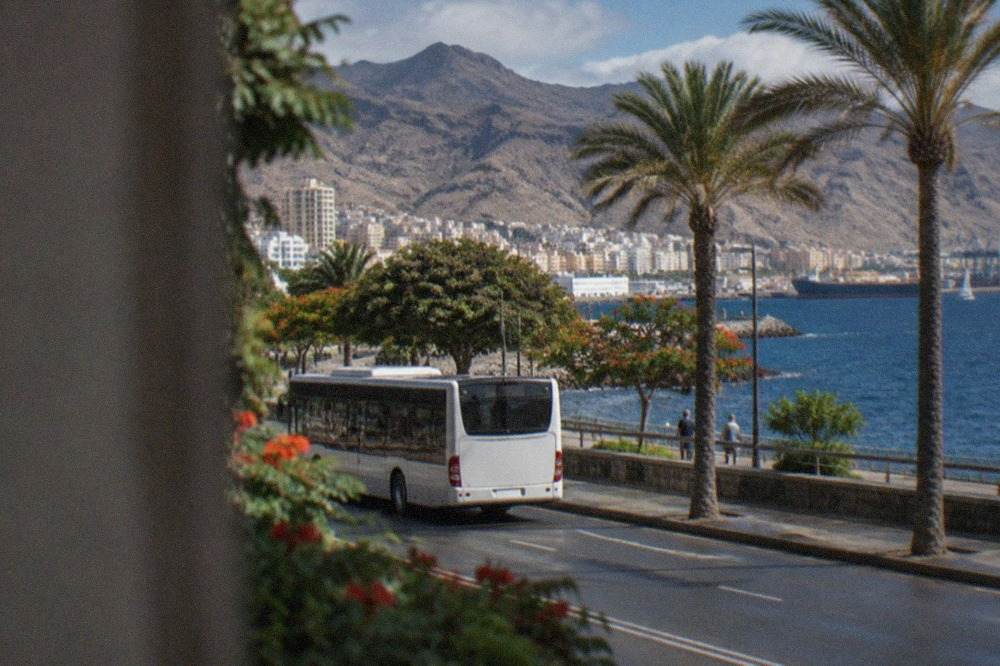
Most visitors combine TITSA buses with a few booked tours and, sometimes, a hire car. Buses serve both airports and every major resort; the tram runs only in the Santa Cruz and La Laguna area; visitors pay for public transport because the 2026 free-pass scheme is for residents only.
Tenerife moved 13,969,678 passengers through Tenerife South Airport in 2025, an all-time record according to AENA, and another 7,174,977 through Tenerife North. Almost every one of those arrivals then faces the same question within an hour of landing: bus, taxi, transfer or hire car. The island answers it well. TITSA runs the buses, Metrotenerife runs a tram between Santa Cruz and La Laguna, taxis are white and metered, and the motorway spine along the south coast makes self-driving straightforward. What trips people up is not the lack of options but the details: which airport the flight lands at, which bus lines actually serve it, and the fact that headlines about free public transport in the Canaries describe a residents' scheme that visitors do not qualify for.
How to Get Around Tenerife
Tenerife is covered by the TITSA bus network, a single tram line between Santa Cruz de Tenerife and La Laguna, white metered taxis, and self-drive car hire. Visitors pay for all public transport: a single ticket, the EUR 10 day travelcard or the EUR 50 seven-day travelcard. The 2026 free-travel scheme covers resident passes only. Most holiday itineraries combine buses with a few pre-booked tours that include hotel pickup.
That combination is worth spelling out, because the island's geography rewards it. The resorts of Costa Adeje, Los Cristianos and Playa de las Américas sit in the south; the capital, the tram and the old university town of La Laguna sit in the northeast; Puerto de la Cruz and the green north face the trade winds. Teide National Park sits in the middle at altitude, and its two permit trails carry booking rules of their own, covered in the Teide summit permit guide.
A traveller staying in one southern resort and doing three or four big excursions can manage comfortably without a car, using buses for local hops and organised tours for Teide, Masca and the boat trips. A traveller who wants the Anaga mountains, the west coast villages or a run of quiet beaches will get far more from a hire car, and the north vs south comparison explains why the two halves of the island feel like different countries.
The rest of this page sets out each mode with the fares and rules the official sources state, so the decision can be made on facts rather than on forum folklore.
Which Tenerife Airport Should You Fly Into?
AENA's names are Tenerife Sur (TFS) in the south and Tenerife Norte-Ciudad de La Laguna (TFN) in the north; the familiar names Reina Sofía and Los Rodeos are not AENA's current titles. TITSA's airport pages list lines 10, 40, 711, 343 and 415 at Tenerife South, and lines 20, 30 and 343 at Tenerife North. There is no tram to either airport.
The airport matters more on this island than on most, because the two terminals sit roughly at opposite ends of the holiday map. Tenerife South is the charter and low-cost hub, closest to Costa Adeje, Los Cristianos and the beaches most visitors picture. Tenerife North, also known as Los Rodeos, serves the capital region, La Laguna and Puerto de la Cruz, and takes most of the inter-island and mainland Spanish traffic.
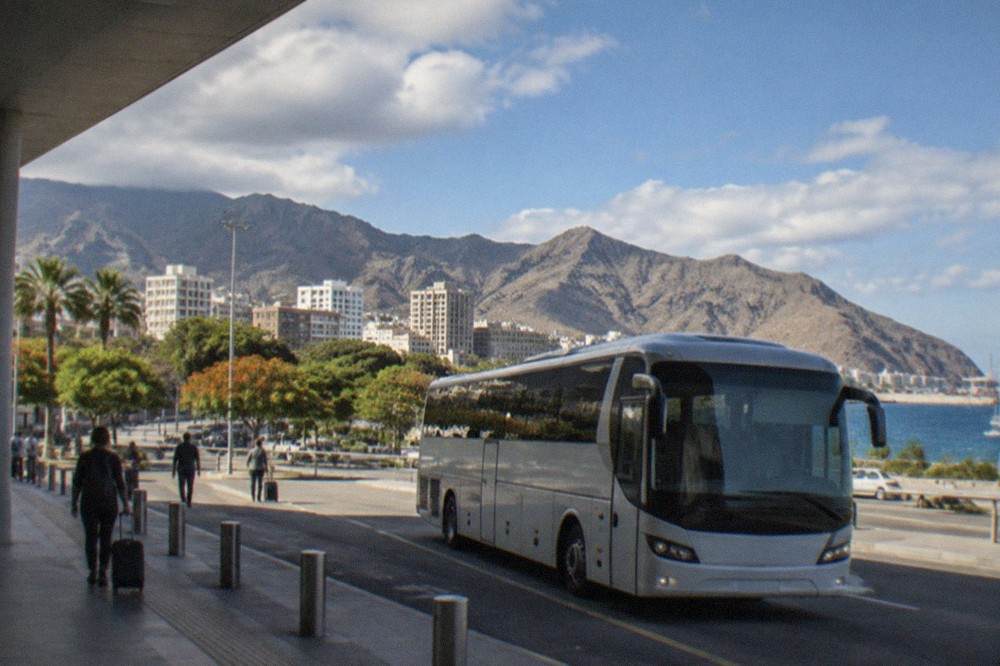
TITSA's own airport pages give the bus lines, and only those lines belong in a plan:
| Airport | TITSA line | Where it goes, per TITSA |
|---|---|---|
| Tenerife South (TFS) | 10 | Santa Cruz |
| Tenerife South (TFS) | 40 | Costa Adeje bus station via Los Cristianos |
| Tenerife South (TFS) | 711 | Night bus: Santa Cruz, airport, Los Cristianos, Costa Adeje |
| Tenerife South (TFS) | 343 | Express Puerto de la Cruz to Los Cristianos via both airports |
| Tenerife South (TFS) | 415 | El Fraile, San Isidro |
| Tenerife North (TFN) | 20 | Santa Cruz via La Laguna |
| Tenerife North (TFN) | 30 | Puerto de la Cruz |
| Tenerife North (TFN) | 343 | Express to the south |
Line 343 is the quiet star of that table: it is the one route that stitches both airports to both coasts, express, and it appears on both TITSA airport pages. Line 711 exists because flights land at hours when nothing else does.
For arrivals at unsociable times, or with luggage that makes a bus unattractive, a pre-booked transfer is the other standard route: arrange an airport transfer ahead of landing. The airport transfers guide and the dedicated pages for Tenerife South Airport and Tenerife North Airport go deeper on each terminal.
If the plan is a holiday built around the south's beaches, the boats and the parks, the excursions below all collect from southern hotels, which removes the airport question from every day except arrival and departure:
How Do the Tenerife Buses Work?
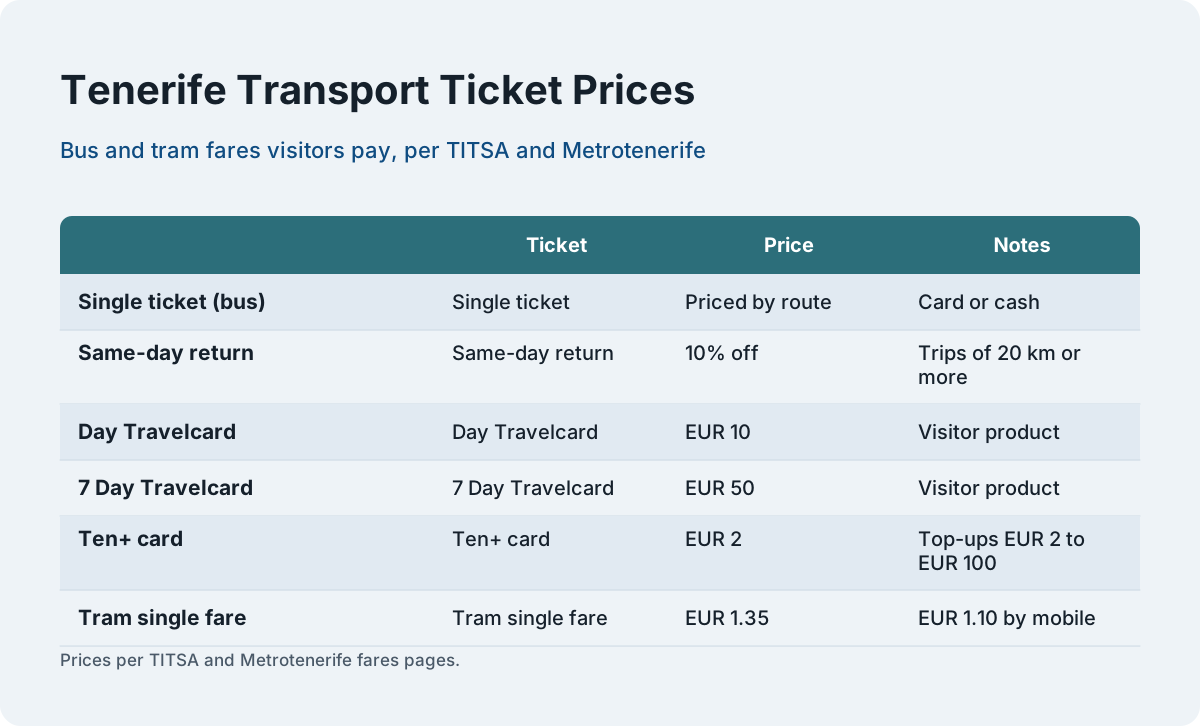
TITSA sells single tickets priced by route, payable by card or cash, with 10% off a same-day return on trips of 20 km or more. Visitor travelcards are the EUR 10 day travelcard and the EUR 50 seven-day travelcard, sold at airport ticket machines. The Ten+ card costs EUR 2 and wallet top-ups run from EUR 2 to EUR 100. Buses serve both airports and every major resort.
The network is the island's real public transport backbone. TITSA's route list reaches the resorts, both airports, Puerto de la Cruz, La Laguna, the Teide road and the west coast villages, including the Teno lines that the resident passes do not even cover. The TITSA buses guide covers the network stop by stop.
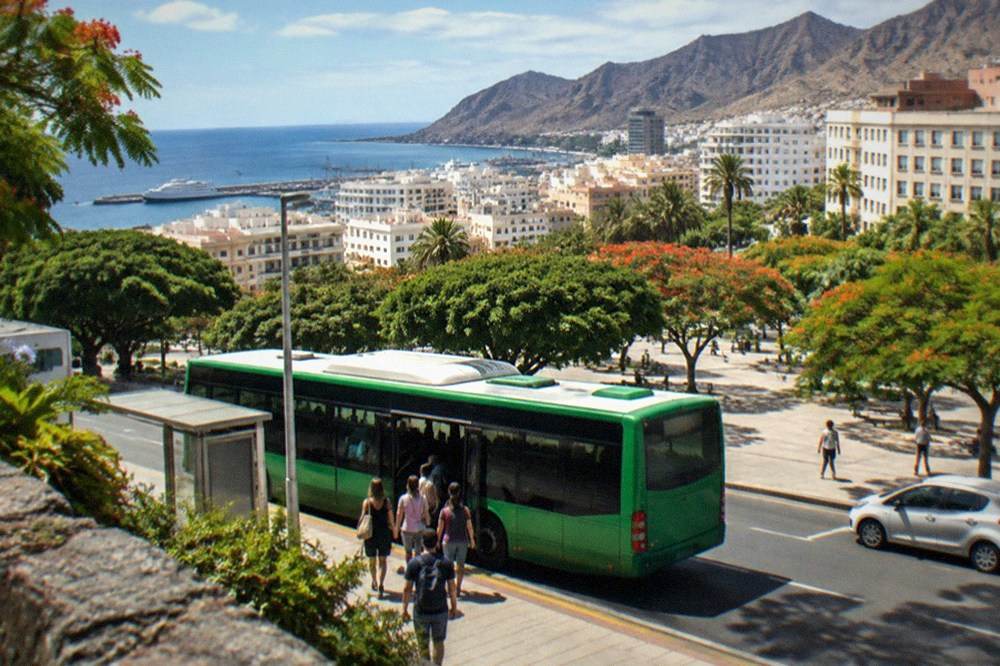
What the fares page actually offers a visitor:
| Ticket | Price | Notes, per TITSA |
|---|---|---|
| Single ticket | Priced by route | Card or cash |
| Same-day return | 10% off | Trips of 20 km or more |
| Day Travelcard | EUR 10 | Visitor product |
| 7 Day Travelcard | EUR 50 | Visitor product |
| Ten+ card | EUR 2 | Wallet top-ups EUR 2 to EUR 100 |
| Airport sales | At ticket machines | Travelcards sold there |
Two practical points follow from those rows. The day travelcard pays for itself quickly on any day with three or more rides, and the seven-day card is the obvious buy for a bus-based week. Neither is a residents' product: both are exactly what TITSA sells to visitors.
The bus also unlocks the island's permit trails, which is a transport fact as much as a hiking one. The Masca gorge descent is only sold to hikers who arrive on TITSA line 355 from Santiago del Teide and show the bus ticket; a private vehicle means refusal at the control. That rule alone makes a bus-free Masca day impossible, and it is the clearest example of the network deciding an itinerary.
Is Public Transport in Tenerife Free?
No, not for visitors. The 2026 scheme subsidises 100% of resident passes and multi-trip tickets, in force since 1 January 2026 under Real Decreto-ley 17/2025, and every subsidised pass requires Canary Islands residency on a personalised Ten+ card. Visitors pay: single tickets, the EUR 10 day travelcard or the EUR 50 seven-day travelcard.
This is the single most misleading headline in Tenerife travel coverage, so it is worth being precise about what the Canary government's own announcements say. The subsidy exists, it is real, and on 15 June 2026 the State committed to the overdue payments and to continuing it. It is also, by its own eligibility rules, a residents' scheme.
| Pass | Who qualifies, per Metrotenerife and the Canarian government |
|---|---|
| Monthly pass | Resident in the Canary Islands |
| Youth pass | Under 30 and resident |
| Child card | Under 10 and resident in Tenerife |
| Ten+ personalised card | EUR 5 via tenmas.es, residency required |
| Visitors | Do not qualify for any subsidised pass |
Metrotenerife's fares page adds one more row worth knowing even for residents' plans: the Teide and Teno lines are excluded from the resident passes. Those are precisely the lines a visitor is most likely to ride, so the exclusion underlines how little of this island's holiday transport the subsidy touches.
The honest summary for a visitor: budget for fares, buy the travelcard that matches the length of stay, and treat any page promising free buses for tourists as out of date.
What About the Tram?
The tram's single fare is EUR 1.35 on a transit pass or EUR 1.10 by mobile, per Metrotenerife's fares page. The tram does not serve either airport: TITSA buses serve both. Metrotenerife's pages do not state any airport connection, so no airport plan should include one.
The tranvía is a city transport system, not an island one. It exists for the Santa Cruz and La Laguna corridor, which is exactly where it excels: two of the island's biggest municipalities, Santa Cruz at 211,957 residents and La Laguna at 161,108, are linked along one of the busiest corridors in the Canaries. The tram guide covers it in detail.
For a holiday based in the south, the tram is a day-trip tool rather than a daily one: ride it when visiting the capital, La Laguna's UNESCO-listed old centre, or the northern side of the island by connecting from a TITSA express. For anyone staying in La Laguna or Santa Cruz itself, it is the local workhorse.
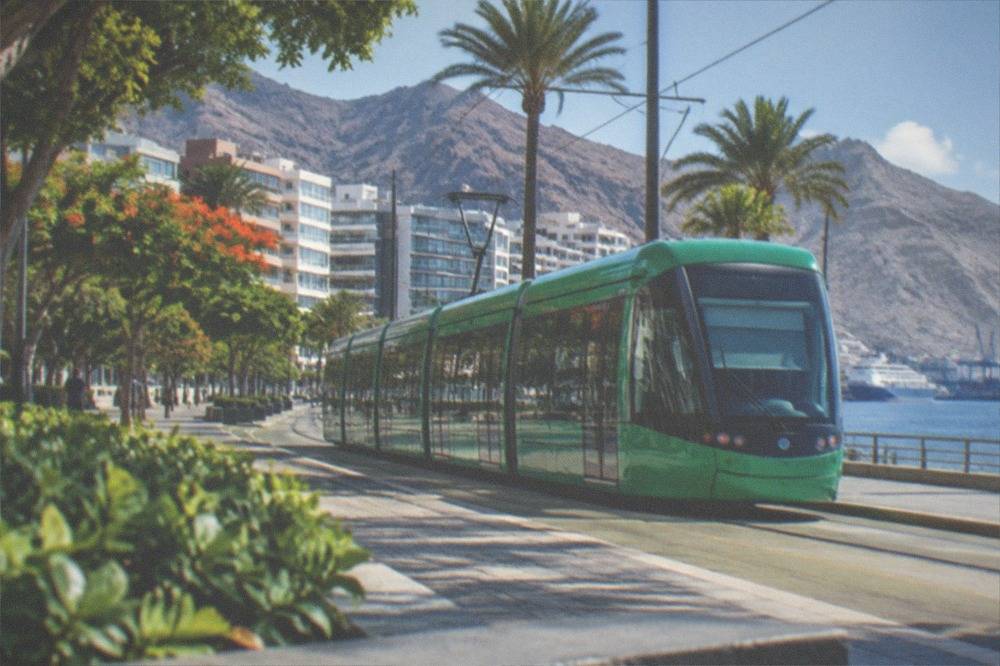
What the tram must never be in a plan is an airport link. No official page states one, and the two TITSA airport pages are the authoritative lists of what serves each terminal. That is the whole answer, and it is a rare case where the correct advice is simply to strike the idea.
Do You Need a Car in Tenerife?
A car is not needed for a resort-based holiday with booked excursions, since TITSA serves the resorts and both airports, but it is the practical choice for Anaga, the west coast, Masca's surrounding villages and flexible days. Taxis are white and metered from the start of every trip, and a fixed price can be agreed in advance for excursions.
The honest answer depends on the itinerary, not the island. Bus-based travel covers the south's resorts, the capital, Puerto de la Cruz and the main Teide road well. It covers Anaga's trailheads and the Teno coast poorly, because frequency thins exactly where the scenery peaks, and the last buses back matter when the light goes. More of these guides are collected on Tenerife Travel Guide.
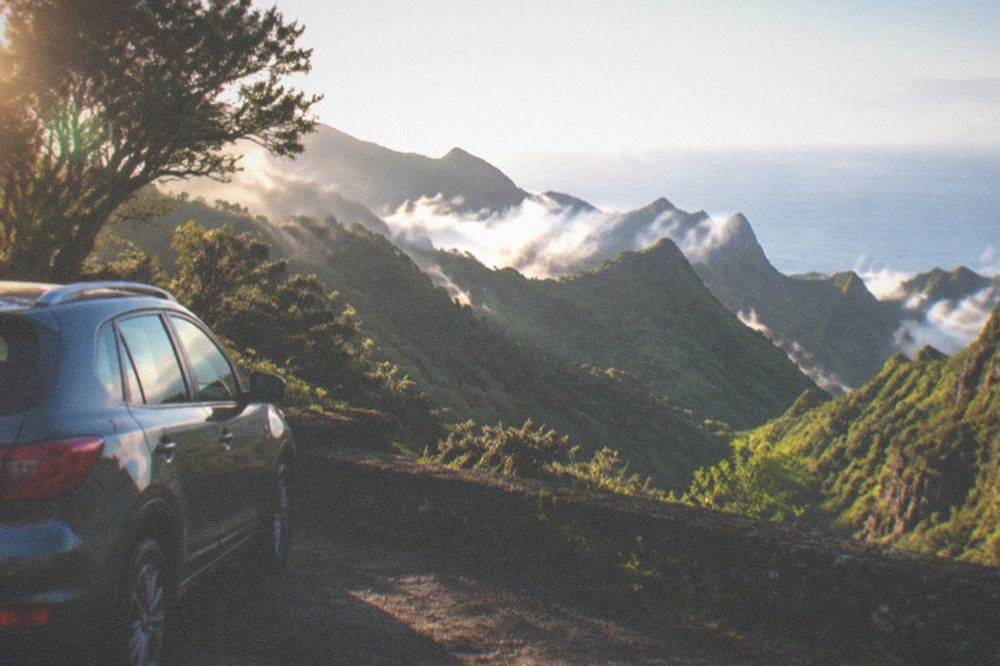
For the flexible option, compare island car hire before committing, and read the car hire guide and the driving rules first. The general drink-drive limit the DGT page refers to is 0.5 g/l in blood, which is lower than the UK's, and the mountain roads demand more attention than the southern motorway suggests.
One rule of thumb the verified sources support: the more of the island a trip tries to see, the more a car earns its keep, and the more it stays in one resort, the more it sits in a car park. The where to stay guide matters here, because the right base can remove the question entirely.
How Do Taxis Work in Tenerife?
Tenerife's taxis are white and all are metered from the start of the trip, per the tourist board's own page. A fixed price can be agreed in advance for excursions, and adapted eurotaxis exist. No regulated tariff is published on any page read, so no fare figure can honestly be printed here.
That last sentence is unusual for a transport guide, and it is deliberate. Plenty of pages quote airport taxi fares; none of those figures comes from an official source on file, and a fare that no official page states is a guess dressed as a fact. What the tourist board does publish is the rule set, and the rules are what a visitor actually needs.
| Taxi rule | What the tourist board states |
|---|---|
| Colour | White |
| Metering | All metered from the start of the trip |
| Excursions | A fixed price can be agreed in advance |
| Accessibility | Adapted eurotaxis exist |
In practice taxis fill the gaps the bus network leaves: early departures, luggage-heavy transfers, and evenings when the timetable has thinned. Agreeing the fixed price before setting off, which the tourist board explicitly permits for excursions, is the one negotiation worth having.
Getting to Teide and the Permit Trails
Driving through Teide National Park needs no booking on any page read, but the two permit trails do: PNT 10 Telesforo Bravo and PNT 07 Montana Blanca, both reserved on Tenerife ON. Since 19 January 2026 the 09:00 to 17:00 slots cost visitors EUR 15 on PNT 10 and EUR 6 on PNT 07 on working days, EUR 10 at weekends. Slots are released every Monday at 07:00 Canary time, keeping 56 days bookable.
The national park is the island's biggest transport question after the airports, because it has three separate things that pages habitually blur. Driving through, and the viewpoints, cost nothing and need nothing. The cable car is an operator ticket to La Rambleta at 3,555 m, with the operator's own health exclusions. The crater trail is a Tenerife ON reservation, and it is not free for visitors.
| Trail and slot | Tenerife residents | Other Canary residents | All other users |
|---|---|---|---|
| PNT 10, 09:00 to 17:00 | EUR 0 | EUR 6 | EUR 15 |
| PNT 07, working days, 09:00 to 17:00 | EUR 0 | EUR 3 | EUR 6 |
| PNT 07, weekends and public holidays | EUR 0 | EUR 5 | EUR 10 |
The fee is set by the place of residence on the ID card or passport, which must be shown with the booking at the checkpoint. Bookings are non-refundable, with no changes of date, slot or names, and a no-show can bar the user from new applications for three months. Children are exempt from the fee; the official page gives two different age cut-offs, so the booking page is the place to check which band applies.
One more rule belongs in any transport plan for the park: the Cabildo bans smoking in every open-air space of Teide National Park, car parks and viewpoints included, as a wildfire measure. The mountain is dry, and the rule is enforced as written.
For visitors who would rather not read a permit page at all, a guided day with hotel pickup handles the logistics:
Getting Around Without a Car: The Realistic Combinations
A car-free week works by pairing the TITSA network with two or three pickup-inclusive tours: buses for the resorts, the capital and Puerto de la Cruz, and tours for Teide, Masca and the boat trips. The visitor travelcards, EUR 10 for a day and EUR 50 for seven days, cover the bus side, and the airport machines sell them on arrival.
The pattern that succeeds is the one that respects the island's shape. The south is flat, linear and bus-dense: Costa Adeje, Los Cristianos and Playa de las Américas sit along one corridor that line 40 and the airport expresses serve directly. The north is greener and hillier, and Puerto de la Cruz connects to it by lines 30 and 343. The middle is Teide, and the middle is where tours earn their keep, because they remove both the permit reading and the mountain driving.
The park tickets make the same argument from the other direction. Loro Parque sits in Puerto de la Cruz and Siam Park in Costa Adeje, at opposite ends of the island, and a combined ticket across both is a transport decision as much as a ticketing one:
For a full car-free itinerary built this way, the 3 days in Tenerife itinerary and its longer siblings lay out the days stop by stop, and the weather by month guide helps pick the season when the bus waits are pleasant rather than punishing.
Getting to the Boats and the Whale Trips
The whale and dolphin boats leave from Los Cristianos, Puerto Colón in Costa Adeje and Los Gigantes, all served by the southern bus corridor, so a boat day needs no car. Authorised boats fly the Barco Azul flag under Decreto 178/2000, which bans any approach within 60 m and any swimming within 500 m of the animals.
The southwest coast between Los Cristianos and Los Gigantes is where the island's resident pilot whales live, a population the World Cetacean Alliance calls unique, inside a Special Area of Conservation. The decree that regulates the boats matters to a transport page because it is the difference between a wildlife trip and a chase: no approach within 60 m, no more than three boats within 500 m, a maximum of 4 knots within 500 m, and no feeding, chasing or circling.
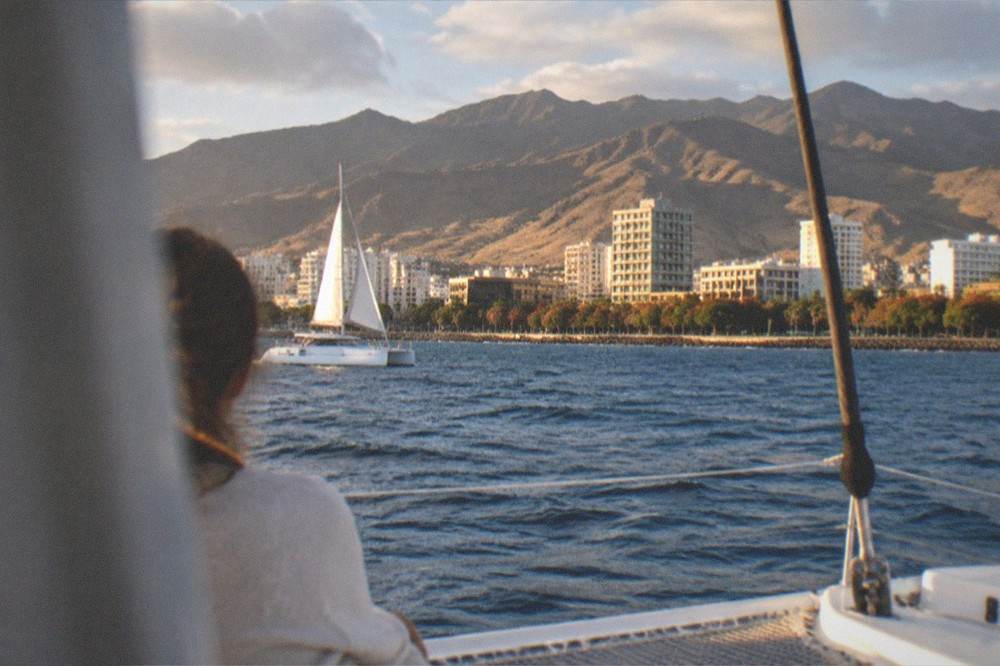
Getting to the departure piers is the easy half. Puerto Colón and Los Cristianos harbour sit on the line 40 corridor, and the Costa Adeje eco-cruise below collects the problem of the last mile itself:
The same logic applies to the island's other big water days, from kayaking with turtles in Los Cristianos to the Los Gigantes cruises with swim stops: the piers are southern, the buses are southern, and a car adds nothing but a parking search.
What the Whole Island Network Looks Like on One Map of Rules
The island's transport rules compress into one short list: TITSA buses cover the resorts, both airports and the permit-trail access points, with visitor travelcards at EUR 10 for a day and EUR 50 for a week; the tram serves only the Santa Cruz and La Laguna corridor and no airport; taxis are white, metered and negotiable by the trip; and the two Teide permit trails carry Tenerife ON reservations with fees set by residence, while driving through the park itself needs no booking.
Pull the modes together and Tenerife's transport settles into that short list of facts a visitor can plan on. The buses cover the island and cost visitors real money, with the travelcards priced above. The tram covers one corridor and no airport. Taxis are metered, white and negotiable by the trip. The national park is drivable without booking, but its two permit trails are reserved on Tenerife ON with fees by residence. Masca's gorge descent requires the TITSA line 355 arrival, which means the bus network is not optional for that walk even for a driver.
The excursions, for their part, exist because the island is bigger than a resort: a week of headline days out, from Teide to the boats to the twin park ticket, is a week in which the only driving decision is whether to hire a car for one free day rather than seven. These are the three that carry the most logistics:
Common Questions About Getting Around Tenerife
What is the best way to get around Tenerife?
For most visitors the best mix is TITSA buses for local and resort-to-city travel, plus two or three organised tours with hotel pickup for the big days out at Teide, Masca and on the water. A hire car is worth it for Anaga, the Teno coast and flexible exploring; the buses cover the southern resort corridor, both airports and Puerto de la Cruz well, and the visitor travelcards are the EUR 10 day card and the EUR 50 seven-day card.
Is public transport free for tourists in Tenerife?
No. The 2026 scheme that subsidises 100% of passes applies to resident passes only, on personalised Ten+ cards, with residency required for every subsidised product. Visitors pay single fares, the EUR 10 day travelcard or the EUR 50 seven-day travelcard, all sold at the airport ticket machines.
Can you get from Tenerife South Airport to Costa Adeje by bus?
Yes. TITSA's airport page lists line 40 to Costa Adeje bus station via Los Cristianos, and the night bus line 711 also serves Costa Adeje. Line 343 runs express between Puerto de la Cruz and Los Cristianos via both airports. No point-to-point bus fare is published on any official page read, so check the fare with TITSA when buying.
Does the tram go to either Tenerife airport?
No. Metrotenerife's fares page states no airport connection, and TITSA's airport pages list only bus lines: 10, 40, 711, 343 and 415 at Tenerife South, and 20, 30 and 343 at Tenerife North. The tram serves the Santa Cruz and La Laguna corridor only.
Do you need a permit to drive through Teide National Park?
No booking of any kind is needed to drive through the park or stop at the viewpoints on any official page read. The reservations apply to two trails only: PNT 10 Telesforo Bravo and PNT 07 Montana Blanca, both booked on Tenerife ON, with visitor fees of EUR 15 and EUR 6 respectively on the daytime working-day slots since 19 January 2026.
Can you visit Masca without a car?
You must, in one sense: hikers on the Masca gorge descent have to arrive on TITSA line 355 from Santiago del Teide and show the bus ticket, and arriving by private vehicle means refusal. The general ticket is EUR 40.66 with the boat exit booked separately, and the return from Los Gigantes runs on TITSA lines 462 or 325.