La Tejita Beach and Montana Roja
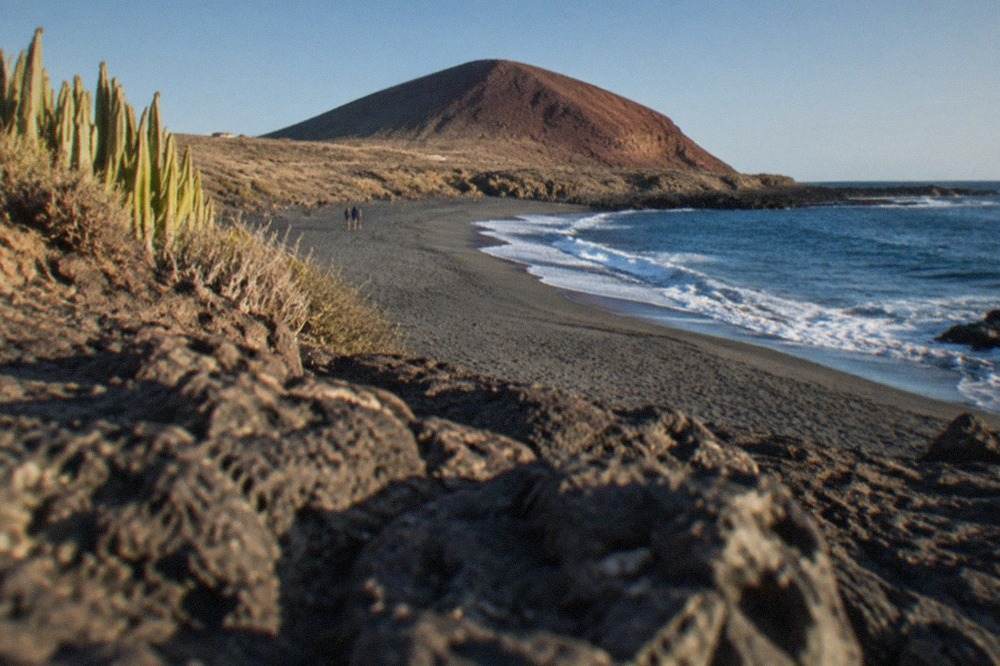
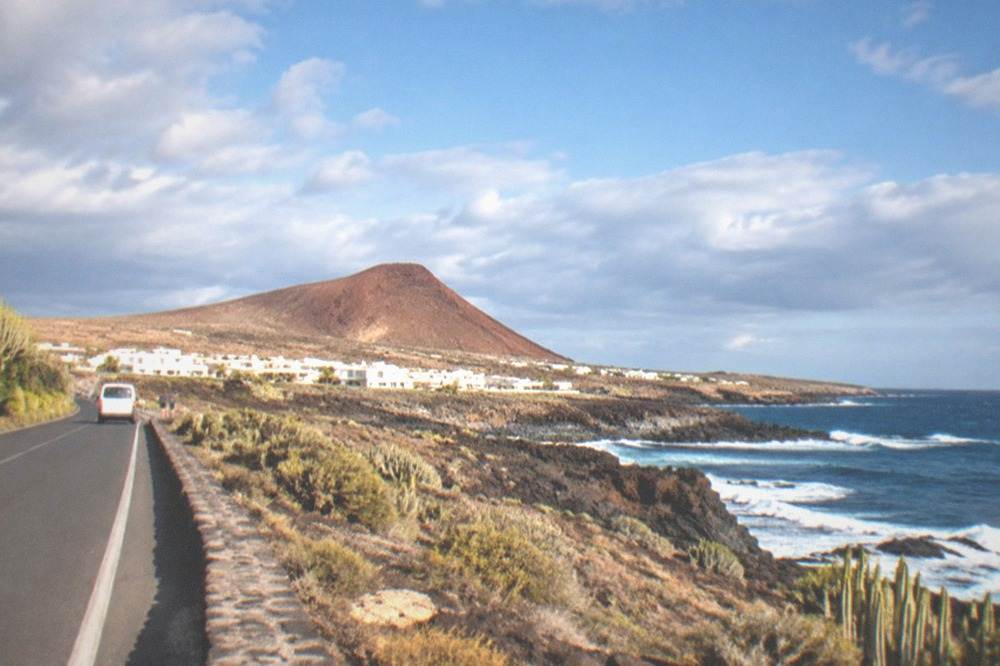
Playa de la Tejita sits in the municipality of Granadilla de Abona, on Tenerife's south coast, under the cone of Montana Roja. The tourist board describes the neighbouring resort beach of El Medano as fine grey sand under the same mountain, and La Tejita belongs to the same unsheltered, wind-facing shore.
Short answer
Playa de la Tejita is a natural beach at the foot of Montana Roja in Granadilla de Abona, south Tenerife, next to the resort of El Medano. It has no entry charge, no permit and no lifeguard service listed on any official page this desk has read, and it is best understood as a walking and kiting beach rather than a swimming lagoon.
Playa de la Tejita sits in the municipality of Granadilla de Abona, on Tenerife's south coast, directly under the volcanic cone of Montana Roja and beside the resort town of El Medano. The tourist board's own page for El Medano describes that beach as fine grey sand lying under Montana Roja, and La Tejita belongs to the same open, wind-facing shore. This desk has read no official page that charges an entry fee, requires a permit or assigns a lifeguard season to La Tejita, so the honest description is a natural beach: free to walk, unmanaged, and shaped by the trade winds that make this corner of the island the centre of its kitesurfing and windsurfing scene.
That openness is the whole point of the place. Where the purpose-built tourist beaches of the southwest, such as Playa del Duque, sit inside hotel zones, La Tejita keeps a stretch of dunes and low vegetation between the sand and the nearest buildings. The trade-off is simple and worth saying early: an unsheltered beach with no breakwaters, in the windiest corner of the island, is a superb place to walk, kite and sunbathe out of season, and a demanding place to swim when the wind is up.
Where Is Playa de la Tejita?
Playa de la Tejita lies on Tenerife's south coast in the municipality of Granadilla de Abona, immediately west of the resort of El Medano and at the foot of the volcanic cone Montana Roja. Tenerife South Airport is the island's second-busiest airfield after Madrid-Barajas in Spanish terms, but the relevant fact here is simpler: the beach sits a short drive from the airport, on the island's southeast corner.
Granadilla de Abona is one of Tenerife's 31 municipalities, with a registered population of 58,752, and it contains both El Medano and La Tejita. The tourist board's page on the area records that El Medano is a fine grey sand beach under Montana Roja, which places the two beaches on the same continuous shore. The cone itself is a protected natural monument, and the walking route around and up its lower slopes is the reason many visitors come here rather than to the sand.
The beach's position matters for planning. It faces mostly south and east, open to the Atlantic swell and the trade winds, unlike the breakwater-protected bays such as Playa de las Vistas in Arona, which the tourist board describes as calm behind a row of breakwaters. Anyone choosing between a family swimming morning and a windy walk should treat those two categories of beach as different products.
What Is the Sand Like at La Tejita?
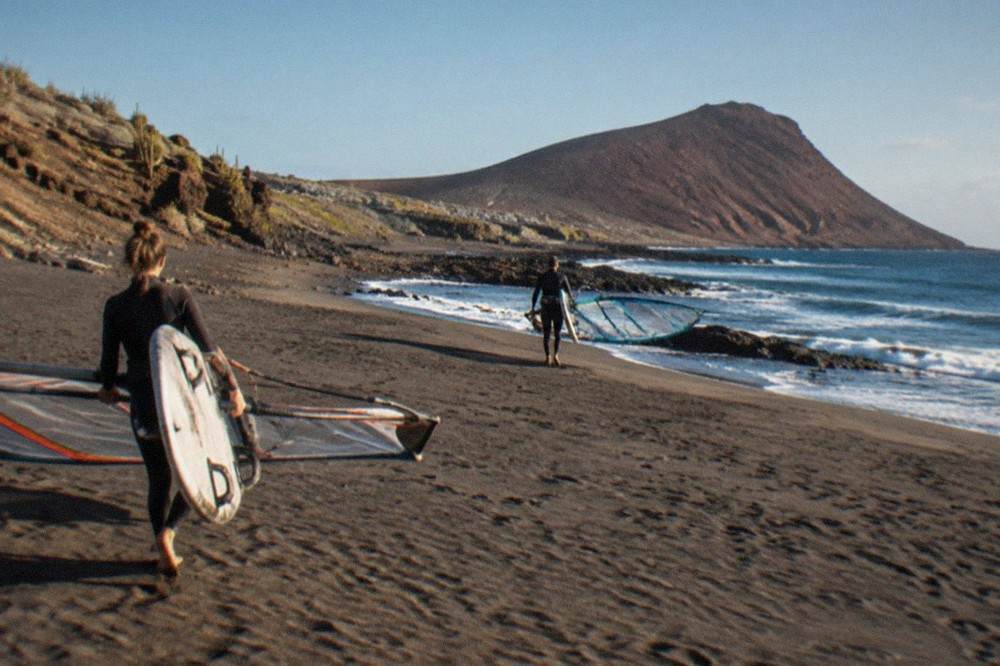
The tourist board describes the El Medano shore, of which La Tejita is the western continuation, as fine grey sand under Montana Roja. No official page this desk has read gives a tonnage, an origin or a replenishment history for sand on this coast, so the honest statement is simply grey volcanic sand, coarser and darker than the golden sand the board attributes to Las Teresitas and Las Vistas.
Sand colour on Tenerife is not a matter of taste, it is a documented fact, and the tourist board states it beach by beach. Its pages describe Playa de las Teresitas as golden sand with palm trees and breakwaters, Playa del Duque as a grey sandy beach, Fanabe as pale sand, and El Bollullo as black sand at the foot of a cliff. La Tejita sits in the grey-sand camp, with the dunes behind the beach adding a second landscape element that the hotel beaches do not have.
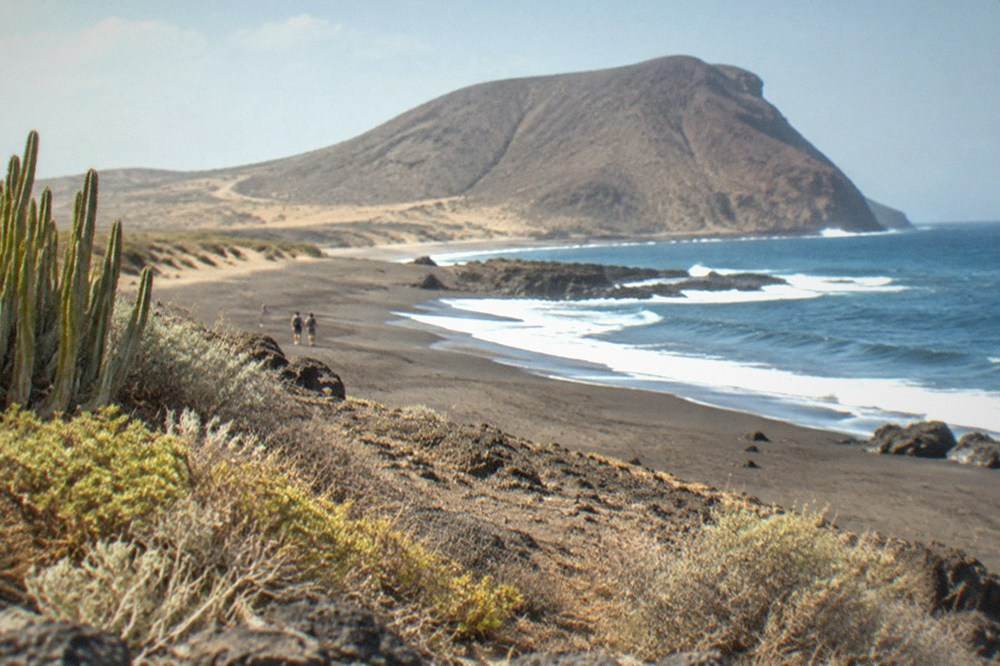
What the dunes mean in practice is a beach that changes shape. Wind moves the sand, and the vegetation line is part of a protected area, which is why the beach keeps a natural profile rather than a raked one. Visitors comparing Tenerife's sand types can see the full range in a single day's drive, from the grey of this coast to the black of Playa el Bollullo in the north.
| Beach | Municipality | Tourist board's sand description |
|---|---|---|
| La Tejita / El Medano | Granadilla de Abona | Fine grey sand, under Montana Roja |
| Playa del Duque | Adeje | Grey sandy beach |
| Playa de las Teresitas | Santa Cruz (San Andres) | Golden sand, palms, breakwaters |
| Playa de las Vistas | Arona | Golden sand, calm behind breakwaters |
| Playa de Fanabe | Adeje | Pale sand |
| Playa el Bollullo | La Orotava | Black sand at the foot of a cliff |
Is It Safe to Swim at La Tejita?
La Tejita is an open beach with no breakwaters, and no official page this desk has read lists a lifeguard service or a flag system for it. The wind that makes the coast a kitesurfing centre also builds swell and surface current, so the sensible reading is that swimming is a calm-day activity, judged on the day, and that the protected bays of the southwest are the reliable swimming alternative.
The comparison with the managed beaches is instructive. The tourist board describes Las Vistas as calm behind a row of breakwaters and Las Teresitas as calmed by breakwaters, which is precisely the engineering La Tejita does not have. This desk will not invent a drowning statistic or a flag decree, because none is on file. What is on file is the structure of the coast itself: open shore, wind, and a beach whose users are overwhelmingly walkers, kiters and windsurfers rather than families with inflatables.
Practical advice that survives the sourcing rule: check the wind forecast for the day, swim close to shore and parallel to the beach rather than out, and if the plan is a swimming day with children, use a breakwater bay. If the plan is a long walk and a kite session, La Tejita is the better choice, and that is a genuine recommendation this desk can stand behind on the documented character of the coast.
Can You Walk Up Montana Roja?
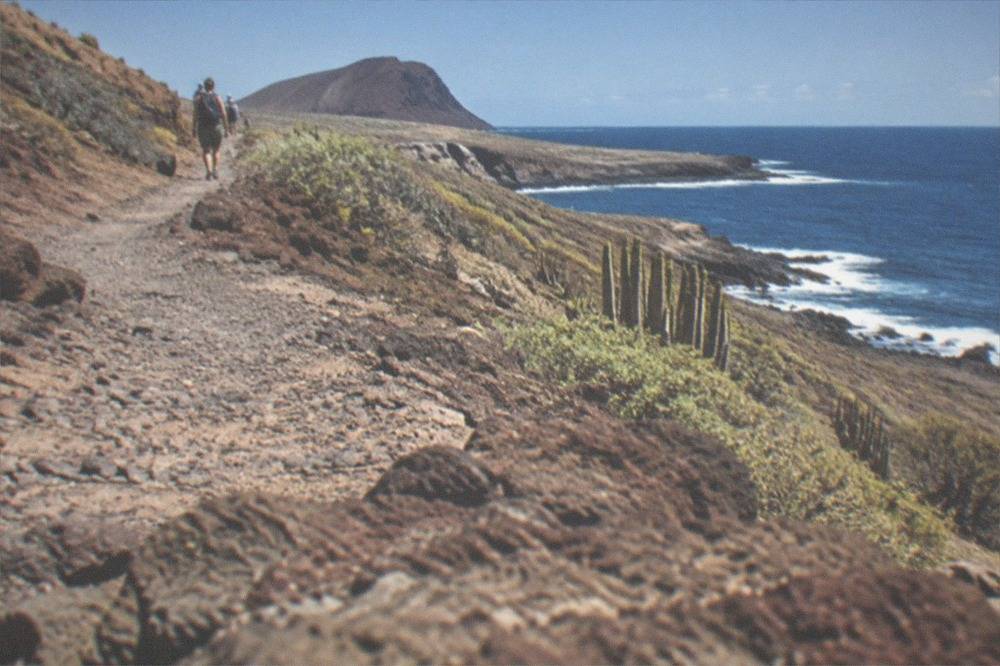
Yes, Montana Roja has a walking route around and partway up its slopes, and no official page this desk has read requires a permit, a fee or a guide for it. The cone is a protected natural monument, so the rule is to stay on the established paths, and the circuit around its base connects the La Tejita dunes with the El Medano seafront.
The cone is the reason this stretch of coast looks the way it does, and the tourist board names it as the landmark of the El Medano beach. Walking the base circuit is free in the way most of Tenerife's natural spaces are free: no charge appears on any official page this desk has read for Montana Roja, which puts it in the same category as the island's other open coastal walks, not in the category of the reservation-only trails. Those do exist on Tenerife, and the contrast is worth knowing. Trails such as PNT 10 Telesforo Bravo on Teide, PNT 07 Montana Blanca, El Pijaral in Anaga and the Masca gorge all require a booking, with fees on some slots. Montana Roja is not on that list on any page this desk has read.
What the walk gives is the best view of the beach itself. From the lower slopes the whole arc of grey sand from El Medano to the dune system reads as one continuous shore, with Tenerife South Airport's approaches to the east. This desk will not state a walking time in minutes, because none was measured on an official page, but the circuit is a half-day outing at a stroll rather than a mountain expedition, and sturdy shoes matter more on the volcanic gravel than on the sand below.
When Is the Best Time to Visit?
The south of Tenerife is dry and warm year round, and AEMET's climate normals for Tenerife South Airport, the station nearest La Tejita, show July and August as the warmest months with mean daily maxima of 27.7 and 28.4 Celsius, and June through August as the driest, with essentially no rain days. Sea surface temperature off the south coast peaks at 23.7 Celsius in September and October, so the warmest water arrives after the warmest air has passed.
The airport station's normals are the closest documented series to this beach, and they describe a genuinely arid shore. Rainfall at the airport averages 132 mm across the year on 15.2 days with 1 mm or more, against 520 mm on 64 days at Tenerife North Airport, which is the single best argument for basing a winter trip in the south. The wind is the other variable, and it is the one the tables cannot show: the trade winds blow most persistently in summer, which is why the kitesurfing season peaks then and why swimmers may prefer the calmer shoulder months.
For a reader planning around weather rather than against it, the pattern is clear. Winter brings the mildest walking conditions and the biggest waves, spring and autumn bring the balance, and summer brings heat, wind and the fullest kite scene. The monthly guides on this site carry the same AEMET data in more detail, including the full station tables.
| Month | Mean daily max (C) | Rain (mm) | Rain days (1 mm+) | Sunshine (hours) | Sea surface (C) |
|---|---|---|---|---|---|
| Jan | 21.7 | 17 | 1.8 | 193 | 19.9 |
| Feb | 22 | 20 | 2.2 | 195 | 19.2 |
| Mar | 23.1 | 15 | 1.9 | 226 | 19.1 |
| Apr | 23.1 | 7 | 1.1 | 219 | 19.5 |
| May | 23.9 | 1 | 0.3 | 246 | 20.2 |
| Jun | 25.4 | 0 | 0 | 259 | 21.4 |
| Jul | 27.7 | 0 | 0 | 295 | 22.2 |
| Aug | 28.4 | 1 | 0.2 | 277 | 23.1 |
| Sep | 27.9 | 4 | 0.6 | 213 | 23.7 |
| Oct | 26.8 | 12 | 1.6 | 214 | 23.7 |
| Nov | 24.8 | 26 | 1.9 | 193 | 22.5 |
| Dec | 22.8 | 30 | 3.5 | 195 | 21.1 |
The air normals are AEMET's 1981 to 2010 series and the sea figures are a 1991 to 2020 dataset, so the two columns describe different periods and are read side by side, not as one measurement.
How Do You Get to La Tejita?
El Medano and La Tejita sit beside Tenerife South Airport in Granadilla de Abona, and TITSA's own airport page lists lines 10, 40, 711, 343 and 415 as the routes serving Tenerife South. Visitors pay normal fares: single tickets, the EUR 10 day travelcard or the EUR 50 seven-day travelcard, because the 2026 free-travel subsidy applies to resident passes only.
The bus facts come from TITSA's own airport pages, and this desk will not name a line that is not on them. Line 40 runs to the Costa Adeje bus station via Los Cristianos, line 10 runs to Santa Cruz, line 343 is the express between Puerto de la Cruz and Los Cristianos via both airports, and lines 415 and 711 serve local and night routes. From the airport or the surrounding resorts, the journey to El Medano is a short hop on the coastal network, and the beach is then reached on foot from the town. Everything else covered here is indexed on Tenerife Travel Guide.
The resident subsidy deserves a plain sentence, because misleading versions travel fast. The Canary government's 100% subsidy for 2026 covers resident passes on a personalised Ten+ card, and no visitor qualifies for it. Visitors pay the published fares, and the day travelcard at EUR 10 is the sensible product for a day that combines the beach with a look at El Medano town. Drivers should note that the beach has its own access road and car parking area, and that the wind that fills the kites also fills the car with sand if doors are left open.
What Facilities Does the Beach Have?
No official page this desk has read publishes a facilities list for La Tejita, so the honest answer is that it is a natural beach with the services of El Medano town a short distance along the shore, rather than a serviced beach with its own infrastructure. Visitors should plan on bringing water and shade, and on the town's cafes and shops for everything else.
This is the difference between a natural beach and a resort beach, and it is worth spelling out because photographs do not show it. The breakwater bays of the southwest sit inside built-up frontages with restaurants, sunbeds and showers along the sand. La Tejita has the dunes, the cone and the open shore, and its facilities are the ones a visitor carries. The kitesurfing schools and hire outfits of El Medano are the nearest commercial presence, and they exist because of the same wind that shapes the beach.
The planning consequence is simple. A day at La Tejita is a picnic-and-walking day or a session with a kite school, not a sunbed day. Families wanting the full service should look at the managed beaches, and this site's guide to the best beaches in Tenerife sorts the island's sand by exactly this kind of difference.
Is La Tejita Good for Kitesurfing and Windsurfing?
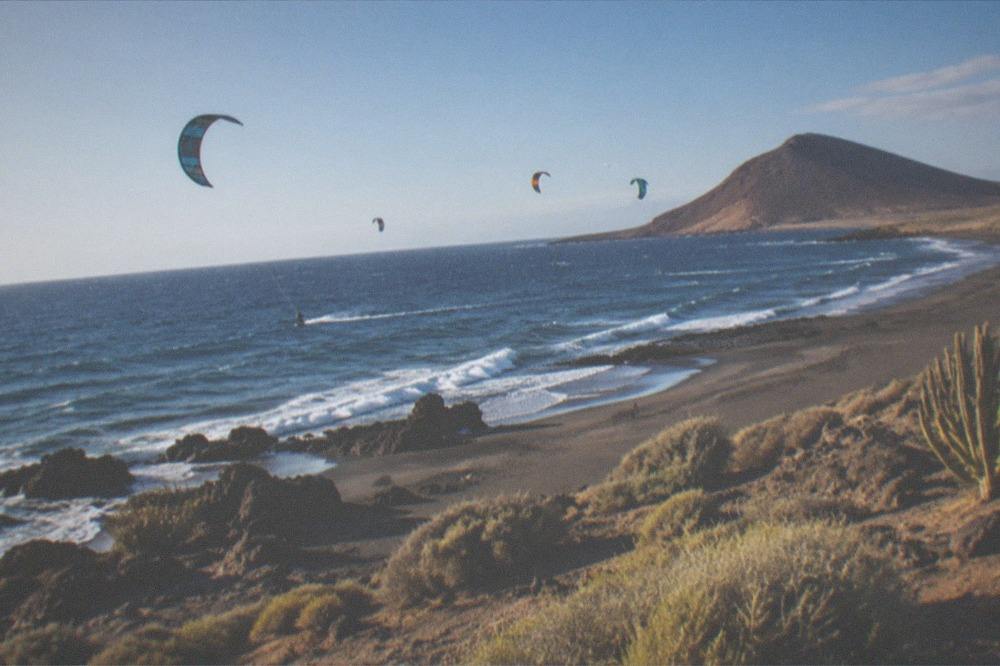
Yes, this corner of the coast is Tenerife's documented centre for wind and kite sports, and the tourist board's page for El Medano names the wind and the fine grey sand under Montana Roja as the defining features of the beach. The same trade winds that make swimming a calm-day activity are the reason the kite and windsurf scene is concentrated here rather than on the sheltered southwest coast.
The beach's geography does the work. An open south- and east-facing shore takes the trade winds more directly than any breakwater bay, and the wide sand gives launch and landing room that rocky coves cannot. This desk will not print a wind-speed statistic, because none is on file from an official source, but the concentration of schools and hire centres in El Medano is itself the evidence: businesses cluster where the conditions are reliable.
For a visitor who wants to try the sport rather than watch it, the practical options are the schools based in El Medano town, reached along the shore from La Tejita. Beginners should book ahead in the high season, and anyone bringing their own kit should check the wind forecast for the day rather than trusting the calendar, because the wind is the whole product here.
What Else Is Near La Tejita?
El Medano town is the immediate neighbour, with its seafront, cafes and the tourist board's fine grey sand beach, and Tenerife South Airport lies just inland in the same municipality of Granadilla de Abona. Beyond that, the southeast corner of the island holds the port town of Los Cristianos, the ferry terminal for the neighbouring islands, and the beginnings of the southwest resort coast.
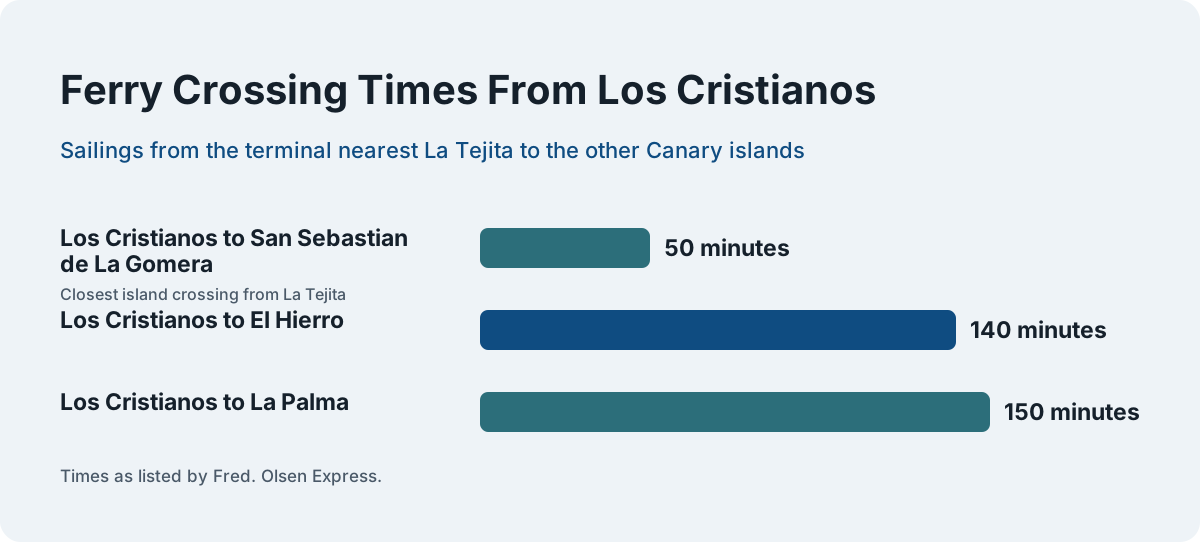
The ferry connection is worth a paragraph, because it turns a beach day into an island day. Fred. Olsen Express lists the Los Cristianos to San Sebastian de La Gomera crossing at 50 minutes, and the same terminal serves La Palma at 150 minutes and El Hierro at 140 minutes. A visitor based near La Tejita can therefore pair the beach with a La Gomera day trip without changing accommodation, and the ferry terminal is a short drive up the coast.
Closer to hand, the walk around Montana Roja's base connects towards the Red Mountain and the quieter coves of the southeast, and the resort of El Medano supplies the evening: restaurants, a seafront promenade and the small-town atmosphere that the big resort zones lack. Visitors wanting to compare the resort personalities can read the site's comparison of Los Cristianos and Costa Adeje before choosing a base.
How Does La Tejita Compare with Other Tenerife Beaches?
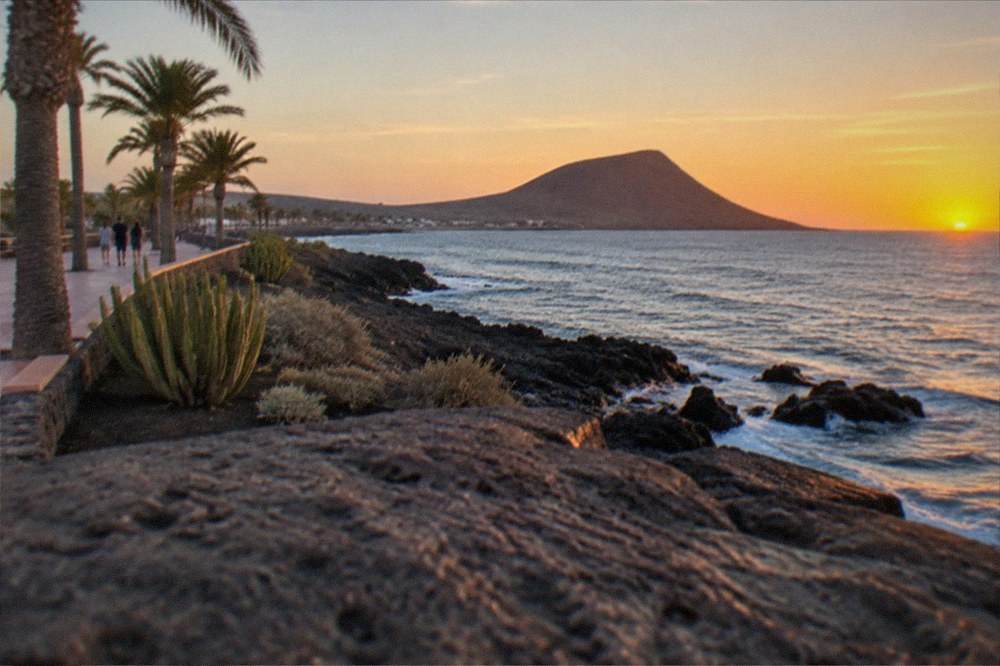
La Tejita is the natural, wind-facing option on a coast where most famous beaches are engineered for calm: the tourist board's own descriptions split the island's sand between grey, golden, pale and black, and between open shores and breakwater bays. The right choice depends on what the day is for, swimming, walking, kiting or sunbathing, more than on any ranking.
The table below assembles the documented differences. Every sand description is the tourist board's own wording, and the shelter column records whether the beach sits behind breakwaters, which is the single biggest driver of swimming conditions on this island. No ranking column appears, because a ranking would be an invented score.
| Beach | Shore type | Sand (tourist board) | Best suited to |
|---|---|---|---|
| La Tejita / El Medano | Open, wind-facing | Fine grey sand | Walking, kiting, windsurfing |
| Playa de las Teresitas | Breakwater bay | Golden sand, palms | Calm swimming, families |
| Playa de las Vistas | Breakwater bay | Golden sand | Calm swimming, families |
| Playa del Duque | Resort frontage | Grey sand | Sunbathing, services |
| Playa el Bollullo | Cliff-foot cove | Black sand | Scenery, walking |
| Playa de Benijo | Open Atlantic cove | Dark volcanic sand | Scenery, surfing |
The pattern to notice is that the golden, calm beaches are the built ones and the grey and black ones are the natural ones. A visitor who wants both can have both in one day, because the island is small enough that a morning of dunes and wind and an afternoon behind a breakwater are a single car journey apart.
Do You Need to Book Anything for a Visit?
The beach itself needs no booking, no permit and no ticket on any official page this desk has read, and Montana Roja's walking routes carry no charge either. The things worth booking on this coast are the paid activities, the kite and surf schools, and the island's big ticketed attractions, and those should be arranged in advance in the high season.
The distinction matters because Tenerife is an island where some natural spaces do require bookings, and a visitor who has read about Teide permits may assume every trail does. The reservation-only list is specific: on Teide, trails PNT 10 and PNT 07 carry public fees on the daytime slots since 19 January 2026, at EUR 15 for visitors on PNT 10's 09:00 to 17:00 slots and EUR 6 or EUR 10 on PNT 07 depending on the day of the week, and in Anaga the El Pijaral trail needs a Tenerife ON reservation. Masca needs a pre-booked ticket and a boat exit, and Barranco del Infierno charges EUR 15 for non-resident adults. Montana Roja and La Tejita are on none of those lists.
So the booking question inverts here: the beach is the free part of the day, and the paid parts are whatever a visitor bolts on. A morning at La Tejita pairs naturally with an afternoon at one of the island's parks, and the card below carries the live price for the island's best-known animal park, which sits in Puerto de la Cruz on the north coast.
Common Questions About La Tejita and Montana Roja
Is Playa de la Tejita free to visit?
Yes. No official page this desk has read lists an entry charge, a permit or a parking fee for La Tejita or for the Montana Roja paths. The charges that do exist on Tenerife apply to specific reservation-only trails and sites, such as the Teide summit trail and the Masca gorge, not to this beach.
Can you swim at Playa de la Tejita?
Swimming is possible on calm days, but the beach is open to the Atlantic with no breakwaters, and no lifeguard service is listed on any official page this desk has read. The tourist board describes the breakwater bays of Las Teresitas and Las Vistas as calm, and those are the safer choice for a swimming-focused day.
How do you get to La Tejita from Tenerife South Airport?
The airport sits in the same municipality, Granadilla de Abona. TITSA's own airport page lists lines 10, 40, 711, 343 and 415 at Tenerife South, and El Medano is a short hop on the coastal network, with the beach reached on foot from the town. Visitors pay normal fares: single tickets, the EUR 10 day travelcard or the EUR 50 seven-day travelcard.
Is Playa de la Tejita the same beach as El Medano?
They are two named stretches of one continuous shore. The tourist board's page for El Medano describes fine grey sand under Montana Roja, and La Tejita is the more natural, dune-backed section at the foot of the cone, west of the town's frontage.
Is Montana Roja a hard walk?
No official page this desk has read grades the route or states a walking time. The base circuit is a gentle coastal walk on volcanic gravel, and the paths partway up the cone are steeper but short. Sturdy shoes are the sensible equipment, and the best views of the whole beach come from the lower slopes.
When is the sea warmest at La Tejita?
Sea surface temperature off the south coast peaks at 23.7 Celsius in September and October, according to the 1991 to 2020 dataset, so the warmest water arrives just after the warmest air, which AEMET's normals put in July and August.