How to Pronounce Tenerife
How to pronounce, spell and say Tenerife, with the Spanish stress pattern, the common English mispronunciations, and what official sources say about the name's meaning.
Few place names in Spain are said as differently by visitors and by the people who live there as this one. The island's name arrived in English through centuries of shipping charts and holiday brochures, and along the way it was flattened, clipped and given an ending it never had. The Spanish version keeps a syllable that English habitually throws away, and restoring it is the single fastest way to sound less like a brochure and more like somebody who has read a timetable. This desk has gone through the name the way a linguist would: syllables, stress, spelling, and the one question about its meaning that no official page will answer outright.
How to Say Tenerife
In Spanish the island is pronounced with four syllables, te-ne-RI-fe, with the stress falling on the third syllable, "ri", and the final "e" spoken in full as a "feh", never silenced. The closest English rendering is "ten-er-EE-feh". Spanish spelling rules fix the stress on that third syllable, so speakers on the island all say the name the same way, and the common English habit of ending on "reef" quietly deletes a whole syllable from the word.
The mechanics are simple once they are laid out. Spanish is a syllable-timed language in which every vowel gets its full value: the four vowels in the name are pronounced "eh", "eh", "ee" and "eh", in that order. There is no schwa, no swallowed middle, and no silent ending. The stress lands on "ri" because of the word's shape: a Spanish word ending in a vowel carries its stress on the last syllable but one unless an accent mark says otherwise, and "Tenerife" carries no accent mark, so the stress sits where the spelling puts it.
English speakers make two predictable moves away from this. The first is compression: the middle vowels shrink, and "Tenerife" becomes three syllables, something like "TEN-uh-reef". The second is ending substitution: English words that end in "-ife", such as "knife" or "life", train the mouth to finish on an "f" sound with no vowel after it, so the final "feh" disappears. Both habits are understandable, and neither will confuse anybody on the island, since hotel desks, taxi drivers and bus drivers hear the flattened version all day. But the four-syllable form is the one that appears in every Spanish sentence a visitor will hear, from airport announcements to the recorded stops on the TITSA buses.
| How it is said | Syllables | Where it is heard |
|---|---|---|
| Spanish: te-ne-RI-fe | Four, stress on the third | Airport announcements, bus stops, local conversation |
| Flattened English: TEN-uh-reef | Three, stress on the first | Common among visitors; understood everywhere on the island |
| Over-corrected: ten-er-REEF-ay | Four, wrong ending | A mistaken attempt to add a Spanish-sounding finish; the name has no such ending |
| Portuguese-influenced: Teneriffe | Varies | An older spelling-and-sound form from historic charts; not the modern name in either language |
The over-corrected form deserves a note, because it is the one that surprises people. Some visitors, having learned that Spanish final vowels are pronounced, add an "ay" to the end, as though the name were "Tenerifay". It is not. The word ends in the letter "e", and in Spanish that letter is a plain "eh". Saying the four syllables evenly, with a small push on "ri", produces the island's own version of its name.
Once the name itself is settled, the practical part of a trip starts, and for most visitors that means the water. The south coast is where the island's best-known boat trips run, and the pilot whales off Costa Adeje are the reason so many of them exist.
How Do You Spell Tenerife
Tenerife is spelled with eight letters, T-e-n-e-r-i-f-e, with a single "r", no accent mark, no hyphen and no capital letter inside the word. The spelling is identical in English and in Spanish, so the same eight letters appear on a flight booking, a Spanish road sign and an official tourism page. The recurring misspellings are a doubled "r" as in "Teneriffe", a final "a" as in "Tenerifa", and a stray hyphen after "Tener".
Spelling errors on this name have a history. The doubled-r form "Teneriffe" appears on old English-language maps and shipping records, and it survives today in place names as far away as Edinburgh, where a street called Teneriffe commemorates a wine trade connection. Because that older form circulated in print for so long, it still surfaces in internet searches and gets copied into travel forums. The modern name, in both English and Spanish usage, has one "r".
The single "r" matters for another reason: it changes nothing about the sound, because a single "r" between vowels in Spanish is a soft tap, closer to the quick middle sound in the English word "butter" as said casually than to the rolled "r" many learners expect. Visitors who worry about rolling this name need not. The "r" in Tenerife is one of the gentlest sounds in the word.
A spelling note that saves genuine confusion: the island's name never appears with the Spanish definite article attached. It is "Tenerife", not "El Tenerife" or "La Tenerife". Spanish does attach articles to some island names in casual speech, but this one stands alone, the way it does on the airport signs. AENA, the Spanish airport operator, titles its two Tenerife pages Tenerife Sur and Tenerife Norte-Ciudad de La Laguna, and neither uses an article before the island's name.
For visitors who want the island's own take on its language, the page on what language is spoken in Tenerife covers how Spanish and the Canary accent work in practice, and the page on where Tenerife is pins down the geography that the name belongs to.
What Does Tenerife Mean
No official source consulted by this desk states a verified meaning for the name Tenerife. The word is generally attributed to the language of the islands' original inhabitants, and popular guides offer translations along the lines of "snow-capped mountain", but no government page, museum page or tourist-board page in this site's research files records a confirmed translation, so none is printed here. The honest answer is that the name's meaning is not settled on any official record this desk has read.
This is a case where honesty is more useful than a confident story. The "snow-capped mountain" translation is repeated so widely, in so many guides, that it reads as established fact. But repetition is not verification, and a translation repeated without a source is exactly the kind of claim this site was built to avoid. What can be said, in general and checkable terms, is that the name predates the Spanish language on the island, that it belongs to the indigenous speech of the Canaries, and that the mountain the translation usually points to is Mount Teide, whose summit does hold snow in winter. Those are separate facts, and joining them into "therefore the name means snow mountain" is an inference no official page in this desk's files makes.
The name's uncertain origin has a practical side. Because there is no agreed meaning, there is no "correct" hidden message in the word, and visitors who are told a confident translation on a bus tour or by a guidebook are being told a tradition rather than a documented etymology. Enjoy it as a story, and treat it as one.
The mountain at the centre of that story is real enough, and it is the island's biggest draw. Teide National Park was inscribed by UNESCO in 2007, and Spain's own environment ministry records the peak at 3,715 metres, the highest point on Spanish soil. Seeing it with a guide is the popular route, since the park's trails, permits and cable car rules take some working out in advance.
Why the Name Trips English Speakers Up
The name catches English speakers because it ends in a pattern English does not use: a stressed syllable followed by a full unstressed "feh". English words ending in "-ife" finish on the "f" sound with no trailing vowel, so the mouth is trained to stop early, and the final syllable of Tenerife gets swallowed. Add the Spanish single-tap "r" and the even vowel spacing, and the word asks for three habits English never taught.
The fix is mechanical rather than mysterious. Break the word into its four beats and say them evenly: "teh", "neh", "REE", "feh". Give the third beat slightly more weight, and let the fourth beat exist at all. That last instruction is the whole difficulty. Most English attempts are not mis-stressed; they are simply one syllable short.
The same pattern shows up across the island's place names, and knowing it helps far beyond the island's own name. Spanish place names in Tenerife follow the same rules: full vowels, predictable stress, and an accent mark only where the stress breaks the default pattern. The names below are the ones visitors most often need to say out loud, to a taxi driver or a bus stop announcement.
| Place name | Syllable stress | Note for English speakers |
|---|---|---|
| Puerto de la Cruz | PWER-toh de lah KROOTH | The Spanish "c" before "e" sounds like an English "th" |
| La Orotava | lah oh-roh-TAH-vah | Four full vowels; the "v" is soft, closer to a "b" |
| Güímar | gwee-MAR | The "ü" is a "w" sound; stress on the final syllable, marked by the accent |
| El Médano | el MEH-dah-noh | The accent on the "é" moves the stress forward |
| Icod de los Vinos | ee-KOD de los VEE-nos | The "I" at the start is a full "ee", not "eye" |
| Los Gigantes | los hee-GAN-tes | The "g" before "i" is a throaty "h" sound |
| La Laguna | lah la-GOO-nah | Even vowels, stress on the middle beat |
| Costa Adeje | KOHS-tah ah-DEH-heh | The "j" is a soft, breathy "h" |
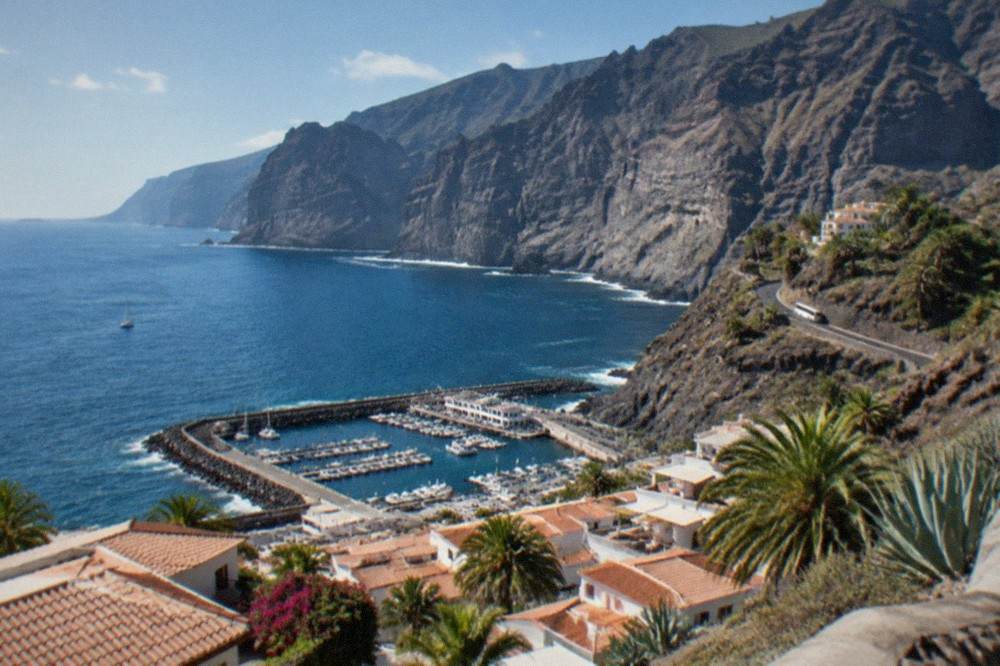
Two of those names reward extra care. "Icod de los Vinos", the town of the ancient dragon tree, is often started with the English diphthong "eye", but the Spanish "i" is a clean "ee". And "Los Gigantes", the clifftop town in the island's far west, is not "los jih-GAN-teez": the "g" before "i" or "e" in Spanish becomes the throaty sound of a Scottish "loch", and the ending is "tes", not "teez". The cliffs themselves rise up to 600 metres in the tourist board's own words, and the town's name is said dozens of times a day on the boat trips that leave from its harbour.
Does Getting the Name Right Matter on the Island?
No official source on Tenerife sets any expectation about how visitors pronounce the island's name, and in practice the flattened English version is understood everywhere in the tourist economy. The value of the four-syllable Spanish form is practical rather than polite: it matches what airport announcements, bus recordings and local people actually say, which makes timetables, stops and directions easier to follow.
There is no etiquette rule at stake. The island hosted 7,412,046 tourists arriving by air in 2025, on the Instituto Canario de Estadistica's count, and its airport, Tenerife South, handled 13,969,678 passengers in the same year according to AENA, an all-time record. A population that busy has heard every version of its own name, and the UK alone accounted for 2,057,896 of the tourists lodged in hotels and apartments in 2025, the tourist board's figures show. The anglicised form is part of the daily background noise, and nobody is being graded.
Where pronunciation does pay is in listening rather than speaking. Bus announcements, ferry terminals and recorded information use the Spanish form, and a visitor who knows the name has four syllables will catch it correctly over a loudspeaker, instead of scanning the board for a word that sounds different from the one expected. The same applies to the place names in the table above: recognising "hee-GAN-tes" as Los Gigantes on a ferry announcement is easier once the sound and the spelling have been connected.
For more on the island behind the name, the pages on how big Tenerife is and the capital of Tenerife fill in the geography, and the planning question of how many days to spend in Tenerife is the natural next step once the flights are booked. This desk's own Tenerife Travel Guide hub collects the rest.
Common Questions About Pronouncing Tenerife
how to pronounce tenerife
Say it with four syllables, te-ne-RI-fe, stress on the third syllable and a full "feh" at the end: roughly "ten-er-EE-feh". The final "e" is never silent, and the single "r" is a soft tap rather than a roll.
how to spell tenerife
Eight letters, T-e-n-e-r-i-f-e, with one "r", no accent and no hyphen. The doubled-r form "Teneriffe" is an older English spelling that survives in historic documents and a few street names, but it is not the modern name in English or Spanish.
Is the English version "Tena-reef" wrong?
It is a shortened form rather than an error anyone will correct. It drops the final syllable and moves the stress, so it does not match what local speakers say, but it is understood across the island's tourist economy without difficulty.
Do I need to roll the "r" in Tenerife?
No. A single "r" between vowels in Spanish is a quick tap, like the middle sound in a casual English "butter". The rolled "r" belongs to doubled "rr" or word-initial "r", neither of which appears in this name.
Do place names on the island follow the same rules?
Yes, the same principles apply: full vowels, stress on the last syllable but one unless an accent mark moves it, and letters such as "g" before "e" or "i" taking the throaty "h" sound heard in Los Gigantes. The table above lists the names visitors say most often.