Where Is Tenerife
Where Tenerife sits on the map: the Atlantic, the Canary Islands, Spain, and which country lies closest to the archipelago.
Tenerife sits in the Atlantic Ocean, roughly level with the northwest shoulder of the African continent, and it is the largest island of the Canary archipelago. It belongs to Spain. The island shares its capital, Santa Cruz de Tenerife, with the island of Gran Canaria under a rotating arrangement between the two, and its resident population stood at about 960,000 on 1 January 2025, spread across 31 municipalities. AENA, Spain's airport operator, records two airports on the island: Tenerife Sur, which handled 13,969,678 passengers in 2025, an all-time record, and Tenerife Norte-Ciudad de La Laguna, which handled 7,174,977. Those numbers tell you something the map does not: this is not a remote outlier, it is one of the busiest islands in the eastern Atlantic.
The rest of this page answers the questions people actually type when they are pinning the island down: which country owns it, which country lies nearest, and why the Canaries are Spanish at all rather than African or independent. Each answer is built from official sources, and where an official figure does not exist, it says so rather than guessing.
Where Is Tenerife Located?
Tenerife lies in the eastern Atlantic Ocean, the largest and most central of the seven main Canary Islands, an archipelago that sits off the northwest coast of Africa and forms the Spanish autonomous community of the Canary Islands. Its two airports, Tenerife Sur and Tenerife Norte-Ciudad de La Laguna, connect it to 34 markets and 159 airports, and its capital, Santa Cruz de Tenerife, held 211,957 residents in 2025.
Zoom out on any map of the eastern Atlantic and the Canary Islands appear as a short chain southwest of the Iberian Peninsula and west of Morocco. Tenerife sits at the centre of that chain, with La Gomera, El Hierro and La Palma to its west and Gran Canaria, Fuerteventura and Lanzarote to its east. Fred. Olsen Express, the ferry operator, gives a sense of the neighbourhood: Los Cristianos on Tenerife's south coast to San Sebastian de La Gomera takes 50 minutes, to Valverde on El Hierro 140 minutes, and to Santa Cruz de La Palma 150 minutes. The same operator runs Santa Cruz de Tenerife to Agaete on Gran Canaria in 80 minutes.
| Ferry route from Tenerife | Operator's sailing time |
|---|---|
| Los Cristianos to San Sebastian de La Gomera | 50 min |
| Los Cristianos to Valverde, El Hierro | 140 min |
| Los Cristianos to Santa Cruz de La Palma | 150 min |
| Santa Cruz de Tenerife to Agaete, Gran Canaria | 80 min |
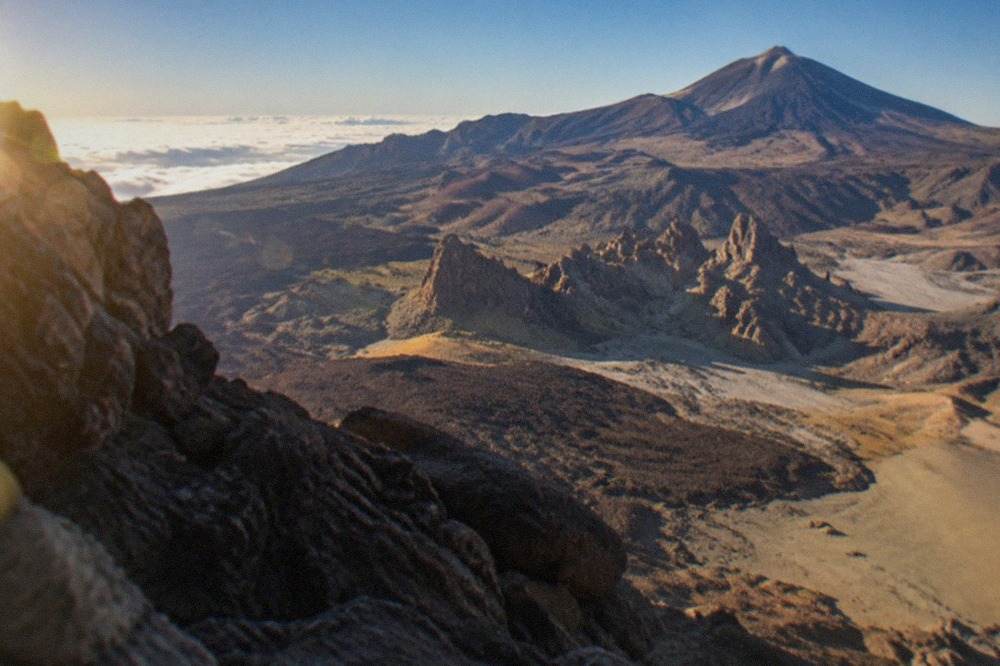
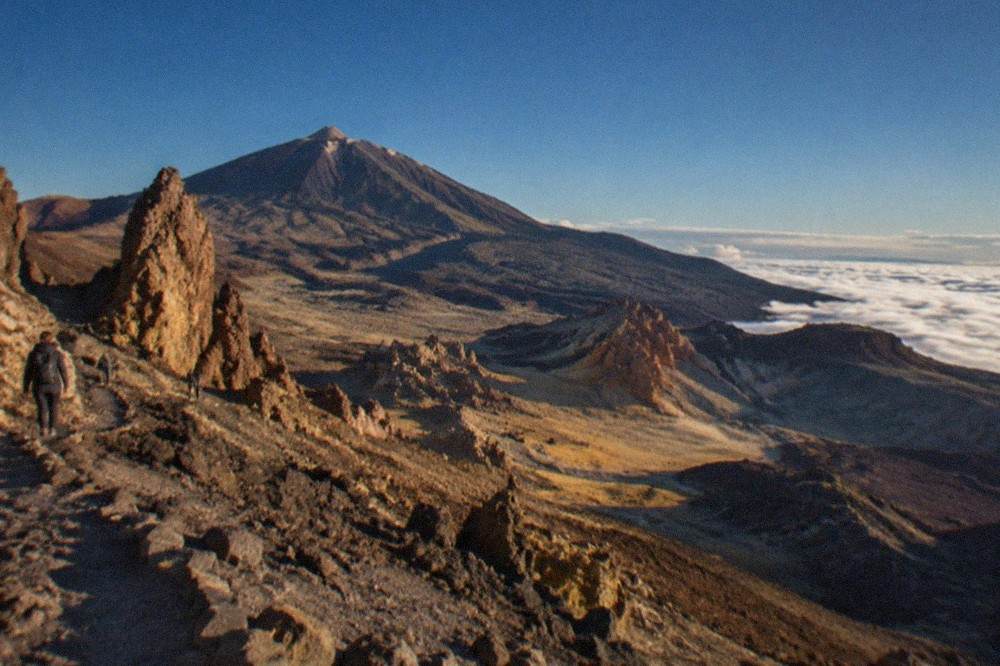
The island's own geography is dominated by Mount Teide, a stratovolcano Spain's environment ministry measures at 3,715 m, the highest peak on Spanish soil. UNESCO, which inscribed Teide National Park on the World Heritage list in 2007, records that the mountain rises 7,500 m above the ocean floor and is regarded as the world's third-tallest volcanic structure. The national park that protects it covered 18,990 hectares when it was declared by decree in 1954, and it received 5,242,653 visitors in 2024, the most visited park in Spain's entire national park network. If you want the island's dimensions rather than its volcano, our page on how big Tenerife is covers that separately.
What Country Does Tenerife Belong To?
Tenerife belongs to Spain. The Canary Islands, of which Tenerife is the largest, are a Spanish autonomous community, one of the seventeen that make up the Kingdom of Spain, so the island's laws, currency, passports and government are Spanish, while its sales tax is the Canarian IGIC rather than mainland VAT.
The practical consequences show up the moment you plan a trip. The euro is the currency. The Canarian tax agency's own table shows IGIC, the Canary sales tax, at 7% on everyday goods, with reduced and elevated bands of 0%, 3% and 15%, and non-resident travellers can claim IGIC back on purchases. Border rules are Spain's rules, which means the EU's rules: the Entry/Exit System, which began on 12 October 2025 and has been fully operational since 10 April 2026, registers UK and US visitors with a facial image and fingerprints instead of a passport stamp. The EU says ETIAS, the planned travel authorisation, is currently not in operation and no applications are being collected, and its fee will be EUR 20 when it launches; no start date has been announced, so none is printed here. Our page on entry requirements for Tenerife goes through all of this in detail.
There is no tourist tax on the island. No official page shows a per-night lodging tax in force or approved on Tenerife, and the charges that do exist are per-booking public fees on specific trails: the Teide summit trail PNT 10, where the 09:00 to 17:00 slots have cost visitors EUR 15 since Monday 19 January 2026, the Montana Blanca trail PNT 07, the Masca gorge ticket and the Barranco del Infierno.
One thing trips up visitors who assume the free-transport headlines apply to them: they do not. The 2026 100% subsidy on public transport in the Canaries covers resident passes only, held on a personalised Ten+ card by people resident in the Canary Islands. Visitors pay for TITSA buses with single tickets, the EUR 10 day travelcard or the EUR 50 seven-day travelcard.
Knowing where the island is also explains what you can do on it. Its position in the Atlantic, inside a Special Area of Conservation that the World Cetacean Alliance designated a Whale Heritage Area in January 2021, means resident pilot whales and bottlenose dolphins live off the south coast year round. Its volcanic centre, protected as a World Heritage site, draws visitors upward to the lava fields of the national park. And its Spanish administration means the island's big parks, like Loro Parque in Puerto de la Cruz, run on the same commercial logic as any mainland attraction.
Which Country Is Closest to the Canary Islands?
Morocco is the country closest to the Canary Islands: the archipelago lies in the Atlantic off the northwest coast of Africa, with the Moroccan coast the nearest mainland, though no distance figure is stated here because none appears in the official sources this site works from. The islands are nevertheless politically and administratively European, tied to Spain rather than to any African state.
That combination, African latitude, European administration, is the defining fact of the islands' location. The climate is what you would expect of an Atlantic archipelago at this latitude rather than of the nearby continent: AEMET, Spain's met office, gives Santa Cruz de Tenerife a July mean daily maximum of 28.7 C and 337 sunshine hours, while the sea off the south coast averages 22.2 C in July and peaks at 23.7 C in September and October. The same AEMET series shows the north of the island wetter: Tenerife North Airport records 520 mm of rain across 64 days with 1 mm or more per year, against 132 mm on 15.2 days at Tenerife South Airport. The tourist board's 2025 balance records where the visitors come from: among tourists lodged in hotels and apartments, the UK led with 2,057,896, followed by mainland Spain with 1,068,407 and Germany with 442,958.
| Tenerife's 2025 figures | Figure |
|---|---|
| Resident population, 1 January 2025 | about 960,000 |
| Biggest municipality: Santa Cruz de Tenerife | 211,957 |
| Second: La Laguna | 161,108 |
| Tourists lodged in hotels and apartments, 2025 | 5,451,268 |
| Tenerife Sur passengers, 2025 | 13,969,678 |
If the map has settled the question for you, timing is the next decision, and the guide to the best time to visit Tenerife works through the monthly numbers.
Why Does Spain Still Own the Canary Islands?
The Canary Islands are Spanish because they are a Spanish autonomous community, with their own regional parliament and government inside the Kingdom of Spain, and no official source on file records any change to that status: the islands' law, currency and borders are Spanish, and Tenerife's own institutions, from its Cabildo to its AENA-run airports, operate under Spanish and EU authority.
The question usually comes from the islands' position on the African side of the map, and the honest answer is that geography and sovereignty simply point in different directions here. Spain's state institutions treat the Canaries as fully national territory: AENA operates both Tenerife airports as part of the Spanish airport network, the national statistics institute INE counts the island's 31 municipalities in the national register, and MITECO, the environment ministry, administers Teide as part of Spain's national park network. The island's own Cabildo, the island council, manages the summit trail reservations through Tenerife ON and bans smoking across every open-air space of the national park as a wildfire measure.
What this site cannot do is supply the history, because the verified facts on file hold no dates for the conquest or the incorporation of the islands into Castile, and invented history is worse than none. What can be said is what stands today: the archipelago is an autonomous community, its residents carry Spanish documents, and its visitors pass through Spain's external borders. Readers who want the fuller story should take it from a primary historical source rather than from a travel site.
Is Tenerife a Country or Part of Spain?
Tenerife is not a country: it is an island, the largest of the Canary Islands, inside the Spanish autonomous community of the Canaries, which is itself part of the Kingdom of Spain. It has no separate citizenship, no separate currency and no seat at the United Nations, and its external border is the EU's Schengen border, operated on the island by Spanish police under Spanish law.
The confusion is understandable, because the island behaves like a small country in everyday ways. It fields its own island council, the Cabildo de Tenerife, which runs the trail reservation system and the national park's access rules. It shares a provincial capital, Santa Cruz de Tenerife, that is also one of the two capitals of the autonomous community. Its sports clubs compete under the Spanish federation, and its football followers will tell you quickly that the question "which country is Tenerife FC in" has only one answer: Spain, because clubs based on the island play within the Spanish league system as a matter of Spanish sporting law.
None of that adds up to statehood. The powers the island exercises are powers Spain devolves to it, the same arrangement that governs the Canaries as a whole and, in different forms, every autonomous community on the mainland. For a traveller, the practical summary is short: fly to Tenerife and you arrive in Spain, in the EU, in the eurozone, on an island that lies off the coast of Africa. If you are weighing the island against other options, our comparison of whether Tenerife is worth visiting and our round-up of what Tenerife is known for cover the decision from the holidaymaker's side, and the wider editorial desk at Tenerife Travel Guide holds a full planning library.
Being an island in the Atlantic also means the sea is never far, and the waters between Tenerife and La Gomera hold a resident population of pilot whales that the World Cetacean Alliance describes as unique, alongside bottlenose dolphins and a migration stop for 21 other cetacean species. Whale watching there is regulated by Decreto 178/2000, which forbids boats from approaching within 60 m, caps speed at 4 knots inside 500 m and bans swimming within 500 m, and authorised boats fly the Barco Azul flag.
Common Questions About Where Tenerife Is
is tenerife part of spain or the canary islands?
Both, because the Canary Islands are themselves part of Spain. Tenerife is an island within the Canary Islands, which form one of Spain's seventeen autonomous communities, so the island answers to the regional Canarian government and to the Spanish state at the same time. There is no contradiction to resolve: the Canaries are the region, Spain is the country, and Tenerife is the island.
which country is tenerife in?
Spain. Tenerife is the largest of the Canary Islands, a Spanish autonomous community in the Atlantic Ocean off the northwest coast of Africa. Its currency is the euro, its airports are operated by AENA as part of the Spanish network, and its visitors enter through the EU's external border.
where is tenerife canary islands
Tenerife sits near the centre of the Canary archipelago in the eastern Atlantic, west of Morocco and southwest of the Iberian Peninsula. La Gomera, El Hierro and La Palma lie to its west, reachable by ferry from Los Cristianos in 50, 140 and 150 minutes respectively on Fred. Olsen Express sailings, while Gran Canaria lies to its east, 80 minutes by ferry from Santa Cruz de Tenerife to Agaete.
where is tenerife island
The island of Tenerife is the largest of the seven main Canary Islands, lying in the Atlantic Ocean off the northwest coast of Africa and belonging to Spain. Its highest point is Mount Teide at 3,715 m, the highest peak on Spanish soil, and its two airports, Tenerife Sur and Tenerife Norte-Ciudad de La Laguna, link it to 34 markets and 159 airports.
does tenerife have its own football team?
The island's clubs compete within Spain's football system, since Tenerife is Spanish territory and its sporting bodies fall under the Spanish federation. So the answer to the related question "which country is tenerife fc in" is Spain: an island-based club rises and falls through the Spanish league pyramid like any club on the mainland.
which country does tenerife belong to?
Spain, without qualification. Tenerife is part of the Canary Islands, an autonomous community of the Kingdom of Spain, and no official source on file records any pending change to that status. Its residents are Spanish citizens, its laws are Spanish and EU law, and its sales tax is the Canarian IGIC, which the regional tax agency sets at 7% on everyday goods.