Are There Mosquitoes in Tenerife?
Mosquitoes, sharks and wild animals in Tenerife, answered from official sources: AEMET climate normals, the Canary whale-watching decree and the World Cetacean Alliance's designation for the Tenerife-La Gomera marine area.
Mosquitoes, sharks and wild animals are the three things holidaymakers quietly type into a search bar before a trip, and Tenerife gets asked about all of them. The island's own official record answers two of the three well and one of them barely at all, and this page keeps to that record: AEMET's climate normals for the island's weather stations, the Canary Islands' whale-watching decree, and the World Cetacean Alliance's designation of the Tenerife-La Gomera marine area. Where no official source says anything, that is stated plainly rather than papered over with folklore.
On mosquitoes, the starting point is climate, because mosquitoes need standing water and AEMET's published normals measure exactly how much rain each part of the island gets. The contrast between Tenerife's coasts is sharper than most visitors expect. AEMET's station at Tenerife South Airport records 132 mm of rain across 15.2 days a year, while its station at Tenerife North Airport, 632 m up at Los Rodeos, records 520 mm across 64 days. The south is dry, the north is damp, and any insect question follows that split. No official Tenerife page read for this article publishes a mosquito count or a mosquito-borne disease figure, so none is printed here.
The practical reading of the AEMET tables is straightforward. In the south, the wettest months by rain days are December with 3.5 and November with 1.9, and June and July record none at all. In Santa Cruz, December carries 5.4 rain days and November 4.7, against a dry June and July. The north stays dampest longest: November carries 8.3 rain days and December 8.8. A visitor packing for Costa Adeje in summer and one packing for Puerto de la Cruz in winter are packing for measurably different climates, and repellent choices can follow the rainfall table rather than guesswork.
Are There Sharks in Tenerife?
No official source read for this page records shark sightings, shark encounters or shark attacks in Tenerife's waters, so no claim about them can be responsibly made either way. What the official record does describe is a marine area between Tenerife and La Gomera that the World Cetacean Alliance designated a Whale Heritage Area in January 2021, holding a unique resident population of pilot whales, bottlenose dolphins and a migration stop for 21 other cetacean species, inside a Special Area of Conservation.
That is the documented marine life of the island: whales and dolphins, in numbers no official page counts. The World Cetacean Alliance's page for the area describes the resident pilot whale population but gives no population figure, and this site does not invent one. The tourist board's own page on the Los Gigantes cliffs records a seabed about 30 m deep at the foot of cliffs that tower up to 600 m, which gives a sense of how steeply the island drops into deep water.
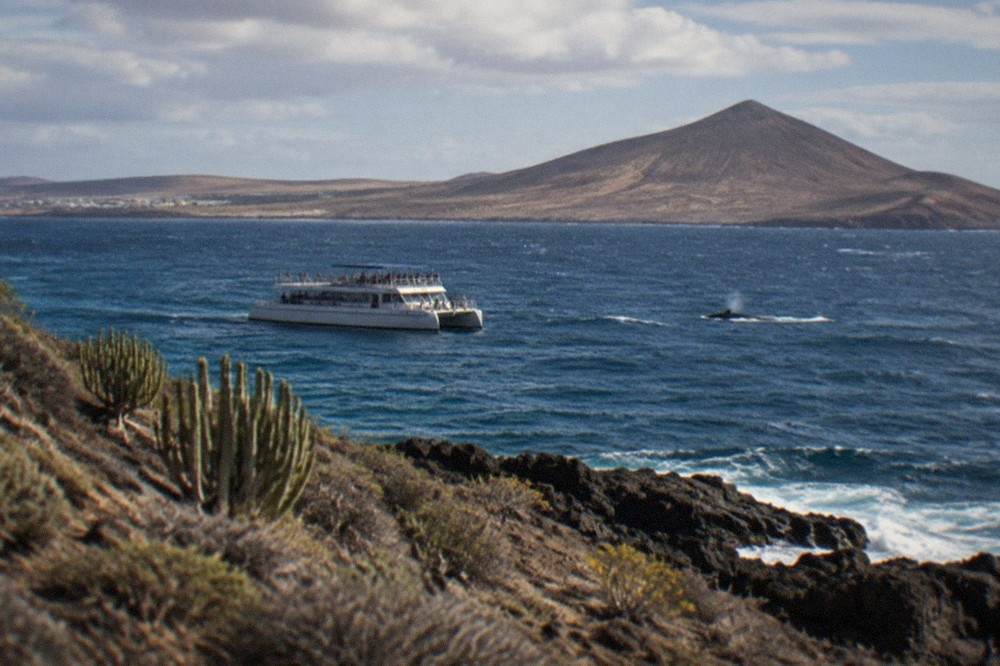
The regulation that governs every boat trip in these waters is Decreto 178/2000 of 6 September, published in the Canary Islands' official bulletin. It exists because the marine area is busy with wildlife watching, and its rules are worth knowing before any trip:
| Rule under Decreto 178/2000 | Figure |
|---|---|
| Minimum approach distance to whales and dolphins | 60 m |
| Maximum boats within 500 m of the animals | 3 |
| Maximum speed within 500 m | 4 knots |
| Swimming or diving within 500 m | Prohibited |
| Feeding, chasing or circling | Prohibited |
| Flag authorised boats must fly | Barco Azul |
If a boat trip is on your list, the Barco Azul flag is the visible proof that the operator holds the Canary tourism department's permit, renewed annually. The decree's distances are the law's own figures, not a guideline, and the question of whether you can swim in the sea in Tenerife is a separate one from swimming with cetaceans, which the decree bans outright within 500 m of them.
Are There Any Wild Animals on Tenerife?
Yes, and the best documented of them live in the sea and in the island's protected parks. The Tenerife-La Gomera marine area holds resident pilot whales and bottlenose dolphins plus 21 other cetacean species on migration, while on land Teide National Park covers 18,990 ha as the largest and oldest national park in the Canaries, and the Los Gigantes cliffs sit inside Teno Rural Park.
The marine area is the island's headline wildlife fact. The World Cetacean Alliance, the body that designated it, describes a unique resident population of pilot whales and bottlenose dolphins, and a migration stop for 21 other cetacean species, all inside a Special Area of Conservation. The designation dates from January 2021 and the programme is now called Whale Heritage Areas; it is a World Cetacean Alliance designation, not a UNESCO one, and no official page states that the area was the first of its kind in Europe.
On land the official record is about protected space more than species lists. MITECO's technical sheet for Teide National Park records 18,990 ha with a peripheral protection zone of 7,374.32 ha, declared by decree on 22 January 1954 and inscribed by UNESCO as World Heritage on 2 July 2007. The park recorded 5,242,653 visitors in 2024, the most visited of Spain's national parks. Teno Rural Park in the northwest holds the Los Gigantes cliffs, and Anaga Rural Park in the northeast carries the laurel forest trails, including El Pijaral, where Tenerife ON requires a prior reservation and expressly does not permit tours run by companies.
How to See Sharks in Tenerife?
There is no official shark-watching listing for Tenerife, and no verified source read for this page describes one. The regulated way to see the island's documented marine wildlife is a whale and dolphin cruise run by a Barco Azul flagged operator under Decreto 178/2000, which keeps 60 m from the animals, limits boats to three within 500 m and bans swimming within 500 m.
In practice that means choosing the boat by its flag and its conduct, not by promises. The decree's rules are checkable before you board: an authorised operator flies the Barco Azul flag, does not chase or circle the animals, and does not put swimmers in the water near them. The resident pilot whales and bottlenose dolphins are the animals the marine area actually holds, and a cruise that respects the decree is the official framework's own answer to wildlife watching here. More of these guides are collected on Tenerife Travel Guide.
The eco-cruise above runs from Costa Adeje under those rules, with food and drinks on board. If wildlife on land is the interest instead, the small-group Teide National Park tour covers the volcanic landscape, and the twin ticket covers Loro Parque, whose animal collection is one of the island's biggest family draws. None of these is a shark trip, because no such product has a place in the verified record.
What Month Are Sharks Most Active?
No official source read for this page says anything about shark activity by month in Canarian waters, so no month can be named. What AEMET and NOAA do publish is the sea itself: the sea surface off the south coast averages 23.7 Celsius in September and October against 19.1 in March, while the south coast's air temperature peaks at 28.4 Celsius mean daily maximum in August.
The seasonal data that exists is about water and weather, and it is worth having when planning any sea-based activity. The sea surface figures come from NOAA's 1991-2020 series for the south coast, and the air figures from AEMET's 1981-2010 normals, two datasets with two periods, which is why they are never blended into one claim:
| Month | Sea surface C off the south coast | Santa Cruz mean daily max C | Tenerife South Airport rain days |
|---|---|---|---|
| Jan | 19.9 | 21 | 1.8 |
| Feb | 19.2 | 21.2 | 2.2 |
| Mar | 19.1 | 22.1 | 1.9 |
| Apr | 19.5 | 22.7 | 1.1 |
| May | 20.2 | 24.1 | 0.3 |
| Jun | 21.4 | 26.2 | 0 |
| Jul | 22.2 | 28.7 | 0 |
| Aug | 23.1 | 29 | 0.2 |
| Sep | 23.7 | 28.1 | 0.6 |
| Oct | 23.7 | 26.3 | 1.6 |
| Nov | 22.5 | 24.1 | 1.9 |
| Dec | 21.1 | 22.1 | 3.5 |
Read as a planning table rather than a wildlife forecast, it says the warmest sea arrives in September and October, the driest air sits over the south from June to August, and the wettest spell on all three measures is November to January. Anyone weighing the best time to visit Tenerife against sea temperatures has the full run of months here, from NOAA's 19.1 Celsius March low to its 23.7 Celsius autumn peak.
What Smell Do Sharks Hate the Most?
No official source read for this page records any smell that sharks dislike, and no repellent substance appears anywhere in the Canary Islands' marine regulations. The only relevant law is Decreto 178/2000, which prohibits feeding the animals in the Tenerife-La Gomera marine area, and that ban covers the baiting and chumming that shark-attraction folklore is built on.
This question circulates widely and the honest answer is that the official record is silent. The decree's prohibition on feeding exists precisely to stop boats altering the animals' behaviour with bait, and a visitor applying the law to their own plans needs nothing beyond it: no chumming, no feeding, no attraction of any kind. The same decree's 60 m approach limit and 500 m swimming ban do the practical work that a repellent myth claims to do, and they carry the force of law.
The same honesty applies to anything a seller puts in a bottle. No verified source for this page endorses a scent, a spray or a device for repelling sharks or, for that matter, mosquitoes, and the island's official pages do not market one. What the official record offers instead is the dry climate data above: the south coast's 15.2 rain days a year against the north's 64 is the measurable fact underneath most insect questions, and the rest is packing sense rather than chemistry.
How to Tell If a Shark Is Near You?
No official Tenerife or Canary Islands source read for this page publishes guidance on detecting a shark's presence, so no sign, behaviour or technique can be listed. The only official rules that touch proximity to marine animals are Decreto 178/2000's: no swimming or diving within 500 m of whales and dolphins, no approach within 60 m by boat, and authorised boats flying the Barco Azul flag.
The decree answers this question by preventing the situation rather than by describing it. Swimmers are kept 500 m from the cetaceans the marine area actually documents, boats are capped at three within that radius and slowed to 4 knots, and the animals are neither fed nor chased. A visitor who wants the reassurance of a rule rather than a folk sign has one: the 500 m line, drawn by the Canary Islands' own government in 2000 and still the framework every authorised operator works under.
Common Questions About Tenerife Wildlife
are there mosquitoes in tenerife
No official Tenerife source read for this page publishes a mosquito count or a mosquito-borne disease figure. What the record does show is a dry south and a damp north: AEMET gives Tenerife South Airport 132 mm of rain on 15.2 days a year and Tenerife North 520 mm on 64 days, so damp-season packing differs sharply by coast.
is there sharks in tenerife
No official source read for this page records shark sightings or encounters in Tenerife's waters, so neither a yes nor a no can be responsibly stated. The documented marine life is the World Cetacean Alliance's Whale Heritage Area between Tenerife and La Gomera, holding resident pilot whales, bottlenose dolphins and 21 other cetacean species on migration.
Do I need insect repellent in Tenerife?
No official page recommends or rates repellents for the island. The measurable basis for a decision is AEMET's rainfall record: the south coast is nearly rainless from June to August, while the north logs 8.8 rain days in December and 8.3 in November, so the damp months and the damp coast are where a bottle earns its space.
Can I swim with the whales and dolphins?
No. Decreto 178/2000 prohibits swimming or diving within 500 m of the animals, along with feeding, chasing and circling, and it caps boats at three within that radius at 4 knots or less. Authorised boats fly the Barco Azul flag, which is the visible proof of a current permit.
Are there dangerous animals in Teide National Park?
No official page read for this source lists a dangerous animal in the park. What the official record does impose is a smoking ban across every open-air space of the national park, trails, viewpoints and car parks included, as a wildfire measure, and mandatory crampons and ice axe on the stratovolcano trails when ice or snow is present.
The short version of this whole page: Tenerife's verified wildlife story is about pilot whales, bottlenose dolphins and protected volcanic landscape, not about sharks or swarms. Pack for the coast you have actually chosen using AEMET's rain-day tables, board only boats flying the Barco Azul flag, and treat the decree's 500 m swimming line as the island's own answer to every proximity question. That is everything the official record supports, and it is enough to plan on.